Empowering Young Voices with the Child Outcome Rating Scale (CORS)
Feedback-Informed Treatment Tools Designed for Children.
Children deserve to be heard. MyOutcomes® brings the power of Feedback-Informed Treatment (FIT) to younger clients through the Child Outcome Rating Scale (CORS) — a validated, visual-based tool that gives children a voice in their therapeutic journey. CORS is a child-appropriate adaptation of the ORS (Outcome Rating Scale), helping therapists track well-being across key areas of life in under one minute.
“Real change starts when even the youngest voices are heard and understood.”
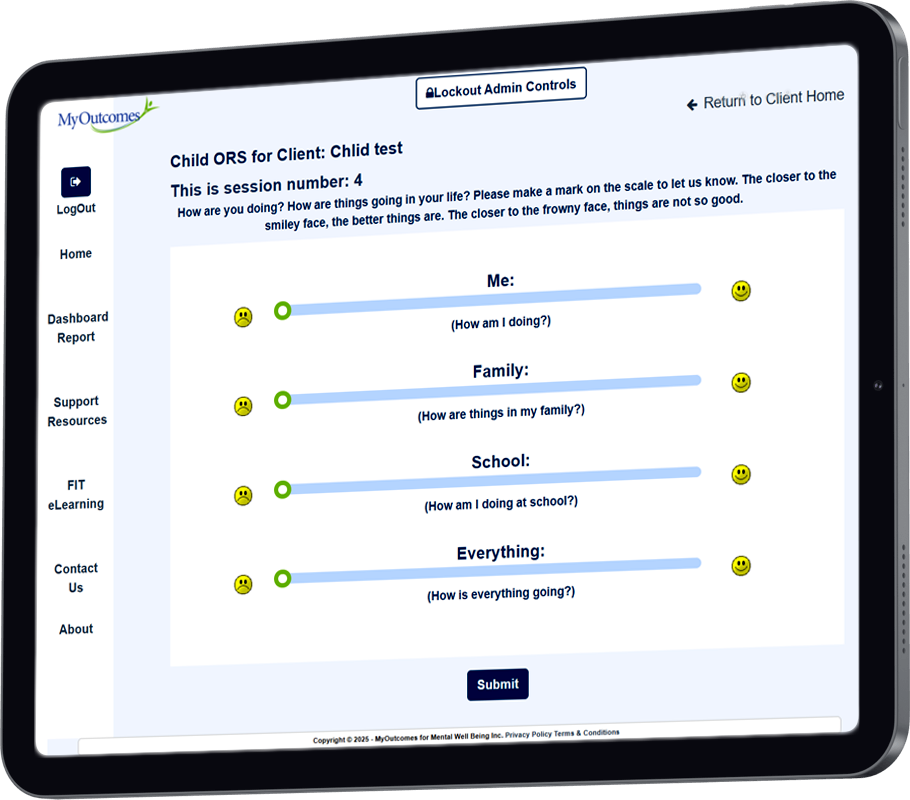
The Child Outcome Rating Scale (CORS) is a validated adaptation of the adult ORS, specifically designed for children aged 6–12. It measures a child’s general sense of well-being across four key areas:
Me
Family
School
Everthing
Each area is rated on a simple visual line with faces or symbols ranging from “not doing well” to “doing very well.” Children move a slider along the line to show how they are feeling, making the process quick, intuitive, and engaging.
Simple and Visual
Efficient
Engaging
Actionable
Compliant
CORS can be administered at the beginning of every session. With continuous use, therapists can: – Identify emerging challenges early – Adapt treatment strategies to suit individual needs – Share outcomes with families and case managers.
The Child Outcome Rating Scale (CORS) is a ultra-brief, four-item visual scale used to track a child’s perception of their own wellbeing and progress during therapy. It is a child-friendly adaptation of the adult Outcome Rating Scale (ORS), designed specifically to help younger clients share their perspective on how they are functioning in a simple, intuitive format.
The Goal: To ensure the child’s “voice” is the primary driver of the therapeutic process.
The Method: Instead of long lists of symptoms, the child uses visual analog scales to show how they are doing.
The CORS measures a child’s functioning across the four most significant domains of their daily life:
- Me (Individual): How the child feels about themselves and their own happiness.
- Family (Interpersonal): How things are going at home and with family members.
- School (Social): How the child is getting along with peers and managing schoolwork.
- Everything (Overall): A general sense of wellbeing and “how life is” in general.
The CORS is specifically designed for children ages 6 to 12. For adolescents aged 13 and older, the standard ORS is generally more appropriate as they transition toward more adult-like self-reflection. For children under the age of 6, clinicians often use “Young Child” adaptations that rely even more heavily on simplified visual cues and play-based feedback.
The CORS is scored by measuring the child’s mark on four 10cm lines and summing them for a total score out of 40.
- Higher Scores (Closer to 40): Indicate better perceived functioning and wellbeing.
- Lower Scores (Closer to 0): Indicate significant distress or impairment.
- The Visual Advantage: Because it uses a visual analog scale (VAS) rather than numbered boxes, it is much more sensitive to subtle “session-to-session” changes in a child’s mood and outlook.
Interpretation of the CORS focuses on the “Trajectory of Change” rather than a single static number.
- The Baseline: The first score sets the starting point.
- Progress Tracking: If scores are increasing, the child is likely benefiting from the current approach.
- Stagnation or Drops: If scores remain low or drop, it is a “real-time signal” for the therapist to change their approach, bring in family members, or explore new barriers at school.
No, the CORS is a wellbeing and progress-monitoring tool, not a diagnostic instrument. It identifies how much a child is struggling in their life, but it does not specify why (e.g., whether the distress is caused by ADHD, anxiety, or situational stress). It is designed to be paired with comprehensive assessments like the PSC-17 or RCADS-25 for a full clinical picture.
The CORS and ORS are functionally identical but linguistically different.
CORS: Uses simpler language (“Me,” “School,” “Family”) and may use icons (like smiley or sad faces) to help younger children understand the scale.
ORS: Uses more mature terminology (“Individually,” “Interpersonally,” “Socially”) suited for teens and adults.
Consistency: Because they follow the same 4-domain structure, MyOutcomes allows clinicians to see a seamless “Growth Story” as a child matures from the CORS into the ORS.
Digital CORS tracking allows children to “mark” their progress on a tablet or screen, making the process feel like an interactive part of the session rather than a test. For the clinician, MyOutcomes instantly calculates the total and graphs it against the Clinical Cutoff (typically 28 or 32 for children). This immediate visual feedback allows the therapist to say, “I see your ‘School’ mark moved up today—what was different this week?” This turns raw data into a powerful therapeutic conversation starter that engages the child in their own recovery.