
Smart reporting for clinicians helps ensure more accurate, secure, and actionable insights for healthcare professionals.
At MyOutcomes, we understand the importance of effective reporting in evaluating clinical effectiveness and enhancing therapeutic outcomes. That is why we offer reports for therapists and reports for administrators.
Therapists can track client progress to inform treatment plans. Administrators can access reports to track clinical outcomes, assessment utilization, client attendance, and data needed for management, funders, and other qualified parties.
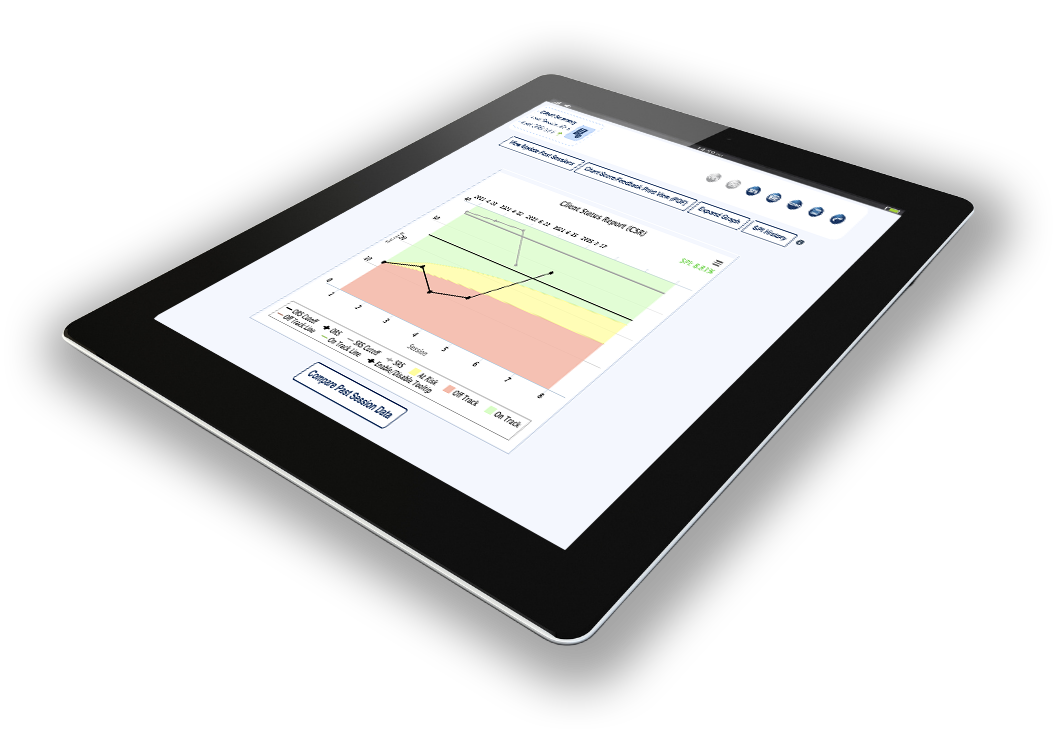
Our platform provides therapists with essential information such as ORS/SRS Feedback, which facilitates real-time insights into client progress and therapeutic alliances. The Predictive Trajectory (CSR) and Success Probability Index (SPI) are two algorithm-generated features that help therapists understand client progress and plan proactive treatment.
Also, the FIT reports and MBC assessment outcomes can be shared with the client as therapeutic aids. Doing so has been shown to improve client goal attainment and treatment outcomes. This process is facilitated using the MyOutcomes App, a user-friendly tool that empowers users to be active participants in their therapy. Within the App, clients can self-assess their mental health status and receive survey results that reflect their progress.
MyOutcomes Smart Reporting offers a variety of options for use by administrators of small to large agencies, government bodies, and health organizations.
Our robust reporting capabilities are designed to track client progress, therapeutic alliance, and the use of assessments and support tools by both clients and therapists.
MyOutcomes provides comprehensive dashboard reports that compile key performance indicators and utilization statistics in an accessible format. Specifically, administrators can assess key operational aspects, including attendance, length of stay, termination reasons, telehealth engagement, and training activities.
In addition, administrators have access to various alert criteria—such as cases identified as at-risk, off-track, or lacking recent data—to ensure timely interventions.
Whether it’s through in-depth reports on individual, family, or group progress or detailed statistical graphs, MyOutcomes facilitates a transparent and effective process for evaluating and enhancing clinical effectiveness across all levels of therapeutic practice.
Summary:
- Therapist reports related to FIT and MBC assessments
- Administration reports with aggregate stats to inform administrative decisions, establish client alerts, and manage practicums
- KPI reports when it is important to narrow aggregate stats into components for funders and other reporting bodies.
Smart Reporting is the practice of transforming raw data—such as patient assessments, attendance, and outcomes—into actionable insights that help clinicians and administrators make faster, evidence-based decisions. Instead of static data storage, Smart Reporting provides live dashboards that flag “at-risk” cases, monitor treatment trajectories, and track operational KPIs (Key Performance Indicators) across an entire practice or agency.
- Therapist View: Focused on individual client progress and treatment intervention.
- Administrator View: Focused on quality assurance, utilization, and reporting for external funders or payers.
Smart Reporting enables directors to monitor the health of their entire practice by aggregating data across all clinicians, teams, and programs. It converts complex data points—like “Length of Stay,” “Assessment Utilization,” and “Off-Track Alerts”—into easy-to-read dashboards, making it simple to demonstrate value to funders, payers, or accrediting bodies.
- Risk Management: Instantly identify cases flagged as “off-track” or “at-risk” for suicide or early termination.
- Operational Efficiency: Track “no-show” rates, telehealth engagement, and therapist training activity in one central hub.
Clinical outcomes reporting provides the objective visibility needed to identify “non-responders” early, allowing therapists to pivot their approach before a client drops out. Research shows that when clinicians have access to routine, data-backed reporting, they can see exactly which treatment models are driving the best outcomes, leading to better clinical decision-making and higher treatment success rates.
A report becomes “Smart” when it is predictive, contextual, and automated. Standard exports are just spreadsheets of raw data; Smart Reporting uses predictive algorithms—like the Success Probability Index (SPI)SPI Success Probability Index—to provide a clear forecast of whether a treatment plan is likely to succeed or if it needs immediate adjustment.
Yes, Smart Reporting significantly reduces the manual labor required for compliance by organizing clinical outcomes into pre-formatted, audit-ready reports. By maintaining a clean, digital trail of assessment usage, symptom reduction, and service utilization, organizations can respond to accountability requirements from health systems and insurance payers with real-time data rather than manual logs.
No, Smart Reporting is a clinical support system—it highlights the “signal,” but the clinician provides the “context.” The reports provide the evidence required to make an informed choice, but the therapist’s expertise remains the essential variable in interpreting how that data applies to a specific client’s unique cultural background, history, and trauma profile.
Therapist-facing reports are designed to enhance the session-by-session client experience, while Administrator-facing reports are designed to optimize organizational performance.
- Therapist Dashboard: Deep-dives into ORS/SRS trends, symptom trajectories, and individual client alerts.
- Administrator Dashboard: Aggregate views of entire clinics, comparison metrics across different departments, and high-level KPIs required for business management.
The most effective reports track a combination of clinical outcomes (symptom change), process measures (attendance/utilization), and the therapeutic alliance (session feedback). By layering these three data sets, an agency can identify not just if their clients are getting better, but how the organization’s workflows are impacting those outcomes.