Empowering Young Voices with the Child Session Rating Scale (CSRS)
Feedback-Informed Treatment Tools Designed for Children.
Children deserve to be heard. MyOutcomes® brings the power of Feedback-Informed Treatment (FIT) to younger clients through the Child Session Rating Scale (CSRS) — a validated, visual-based tool that gives children a voice in their therapeutic journey. CSRS is a child-appropriate adaptation of the SRS (Session Rating Scale), helping therapists track well-being across key areas of life in under one minute.
“Real change starts when even the youngest voices are heard and understood.”
The Child Session Rating Scale (CSRS) mirrors the adult Session Rating Scale (SRS), modified for younger clients with simplified wording and visual anchors. It helps therapists understand how the child experienced each session in relation to:
Listening
Goals
Approach
Overall
The CSRS gives children an accessible format to express how safe, seen, and supported they felt in the session—essential indicators of therapeutic alliance.
Strengthens Alliance
Promotes Collaboration
Identifies Ruptures
Boosts Retention
Easy Administration
Administered at the end of each session, the CSRS invites reflection, engagement, and transparency. When paired with CORS, it creates a full-circle Feedback-Informed Treatment process for youth-focused care.
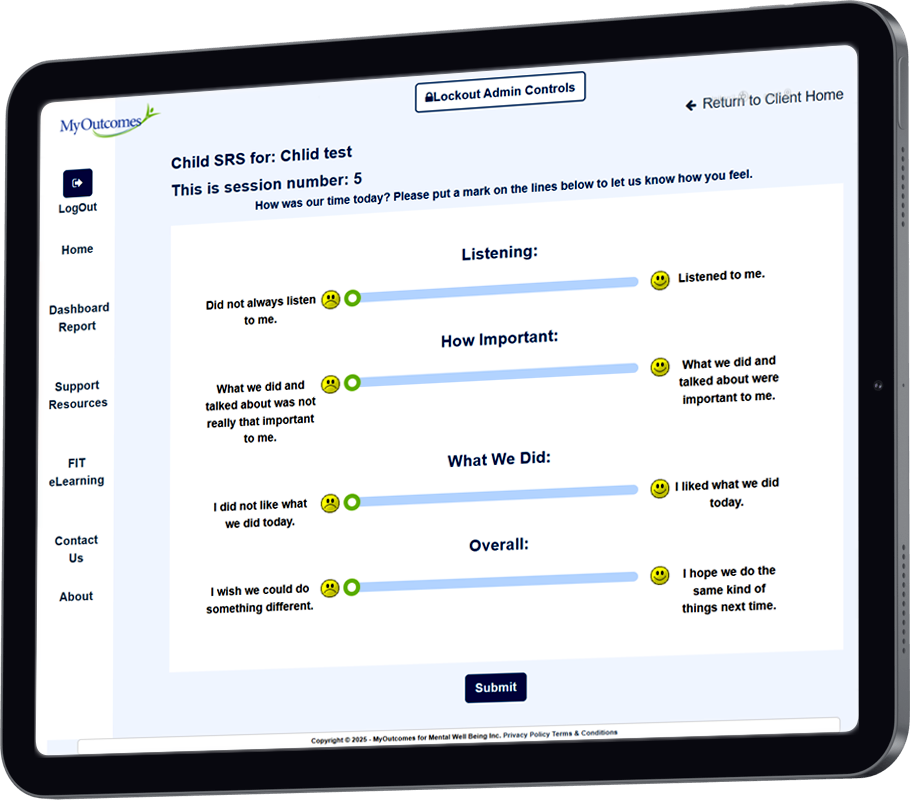
The Child Session Rating Scale (CSRS) is a brief, four-item visual scale used at the end of a therapy session to gather a child’s feedback on the therapeutic relationship. It is the developmentally appropriate version of the adult Session Rating Scale (SRS), designed to help children ages 6 to 12 communicate how they felt about the session in a simple, non-intimidating way.
The Goal: To give the child an immediate voice in the therapy room and to help the clinician adjust their approach in real-time.
The Method: The child “marks” their level of agreement on four visual analog lines representing different aspects of the session.
The CSRS measures the quality of the “Therapeutic Alliance” through four child-friendly domains:
- Listening: Did the therapist listen to and understand the child today?
- How We Worked: Did the therapist’s way of working (playing, talking, drawing) feel right to the child?
- What We Did: Did the session focus on what the child felt was important?
- Overall Session: A general “gut feeling” about how the session went.
The CSRS is optimized for children ages 6 to 12. For teenagers (13 and older), the standard SRSSession Rating Scale is typically used to reflect their maturing cognitive and relational skills. For children under 6, clinicians often use the “Young Child” version (YCSRS), which utilizes simpler icons like smiley faces to bridge the developmental gap.
The CSRS is scored by measuring the child’s marks on four 10cm lines, totaling a score between 0 and 40.
- High Scores (Closer to 40): Indicate a strong alliance and a good fit between the child and the therapist.
- Low Scores (Closer to 0): Indicate a potential mismatch or an “alliance rupture” that needs to be discussed and repaired.
The “Clinical Cutoff” for the CSRS is remarkably high—typically 36 out of 40. Because children often want to please their therapist, they may mark the scale higher than they truly feel.
- Any score below 36 should be viewed as a “risk signal,” prompting the clinician to ask curious, non-defensive questions such as, “I noticed the ‘Listening’ mark is a little lower today—did I miss something important you wanted to say?”
- Interpretation Tip: Even a score of 39 can be a conversation starter if it shows a slight drop from a previous “perfect” 40.
No, the CSRS is an alliance-monitoring tool, not a diagnostic instrument. It does not identify symptoms of ADHD, anxiety, or depression. Instead, it measures the context in which treatment is happening. It ensures that the child is comfortable enough to participate in the “real work” of therapy, which is measured by outcomes tools like the CORS or RCADS-25.
The CSRS and SRS are functionally identical but use different language levels.
- CSRS: Uses simpler, concrete terms like “Listening” and “What we did.”
- SRS: Uses more abstract concepts like “Relational Bond” and “Goals and Topics.”
- Shared Purpose: Both tools serve to foster an environment of “Radical Transparency,” where the client (regardless of age) feels empowered to critique the service they are receiving.
The CORS and CSRS work together as a “Progress and Process” pair.
- CORS: Measures progress (How is the child’s life going overall?).
- CSRS: Measures the process (How was this specific session?).
- The Synergy: If a child’s life is not improving (low CORS) but the alliance is high (high CSRS), the therapist might need to change their intervention. If both are low, the therapist likely needs to focus on repairing the relationship before any symptomatic progress can occur.
Digital CSRS tracking allows children to provide feedback on a tablet or screen, which often feels safer than marking a piece of paper in front of the therapist. MyOutcomes instantly calculates the total and alerts the clinician if the score falls below the 36 cutoff. This allows for “Immediate Alliance Repair,” where the therapist can address concerns before the child leaves the room, significantly reducing the risk of premature treatment dropout.