
(and how you can put the power of feedback-informed treatment into your practice today)
In therapy, the relationship between practitioner and client isn’t just a formality — it’s a central driver of success. Yet many therapists struggle to measure and strengthen that relationship in a consistent, objective way.
That’s where feedback-informed treatment comes in. When used regularly, client feedback can improve the therapeutic alliance by up to 42%, turning therapy from a one-way process into a truly collaborative journey.
The therapeutic alliance is more than just a relationship between a therapist and their client. It’s the foundation of successful therapy. Think of it like the partnership between a coach and an athlete. For therapy to truly work, both the therapist and the client need to be in sync, committed, and working toward the same goal.
It’s built on three key elements:
- Mutual Agreement on Therapy Goals: Both therapist and client understand and agree on what they’re trying to achieve.
- Joint Commitment to the Process: Both are dedicated to the work, even when it’s tough.
- Emotional Bond of Empathy and Trust: This is the heart of the relationship. Clients feel heard and understood, which fosters deeper engagement.
- Research shows that the therapeutic alliance is the strongest predictor of positive therapy outcomes. When clients feel genuinely supported, they’re more motivated and committed to the process.
- Want to learn more? Watch Dr. Scott D. Miller explain why the therapeutic alliance matters in this video.
Watch here
Feedback tools such as the Outcome Rating Scale (ORS) and Session Rating Scale (SRS) create a continuous feedback loop between client and therapist.
- ORS (used at the start of each session) captures the client’s well-being and progress.
- SRS (used toward the end of each session) lets the client rate their experience of the relationship, goals, and approach.
These four-item measures foster open dialogue and empower clients to express what’s working — or not.
When clients share feedback session-by-session, several things happen:
- Clients become more engaged and empowered in their care.
- Therapists receive real-time data to adjust approaches.
- Dropouts decrease because issues are spotted early.
- The alliance deepens because clients feel heard, valued, and involved.
In short, feedback transforms therapy from a service delivered “to” clients into a partnership built “with” them.

Several studies confirm that routine, structured feedback improves therapeutic outcomes and strengthens alliance — often by as much as 42%.
- A meta-analysis by Flückiger et al. (2012) found that seeking client feedback significantly improved therapeutic alliance and outcomes across settings.
- A review of progress feedback by Douglas et al. (2015) in the NIH showed that outcome monitoring enhances communication and helps therapists detect early signs of disengagement.
- Prescott, D. S., Maeschalck, C., & Miller, S. D. (Eds.) (2017). Feedback-Informed Treatment in Clinical Practice: Reaching for Excellence. American Psychological Association.
As outlined in ‘Feedback-Informed Treatment in Clinical Practice’ (Prescott, Maeschalck & Miller, 2017), implementation of FIT tools in everyday practice demonstrates meaningful improvements in therapeutic alliance metrics and client engagement. - Miller, S. D. (2019). Feedback Informed Treatment. In J. C. Norcross & M. R. Goldfried (Eds.), Handbook of Psychotherapy Integration (3rd ed., pp. 105–122). Oxford University Press. In his 2019 chapter on Feedback Informed Treatment, Miller reports that routinely soliciting client feedback via ORS/SRS tools significantly enhances the therapeutic alliance and outcomes across diverse clinical settings.
- Another study of 2,283 clients found that ORS/SRS scores predicted both progress and stagnation — validating their role as reliable predictors of outcome.
- Lambert, Hansen & Finch (2001) reported that systematic feedback doubles therapeutic effectiveness and reduces dropouts by identifying alliance ruptures early.
In other words — feedback isn’t just a nice extra. Research consistently shows that it enhances therapeutic engagement and strengthens outcomes.
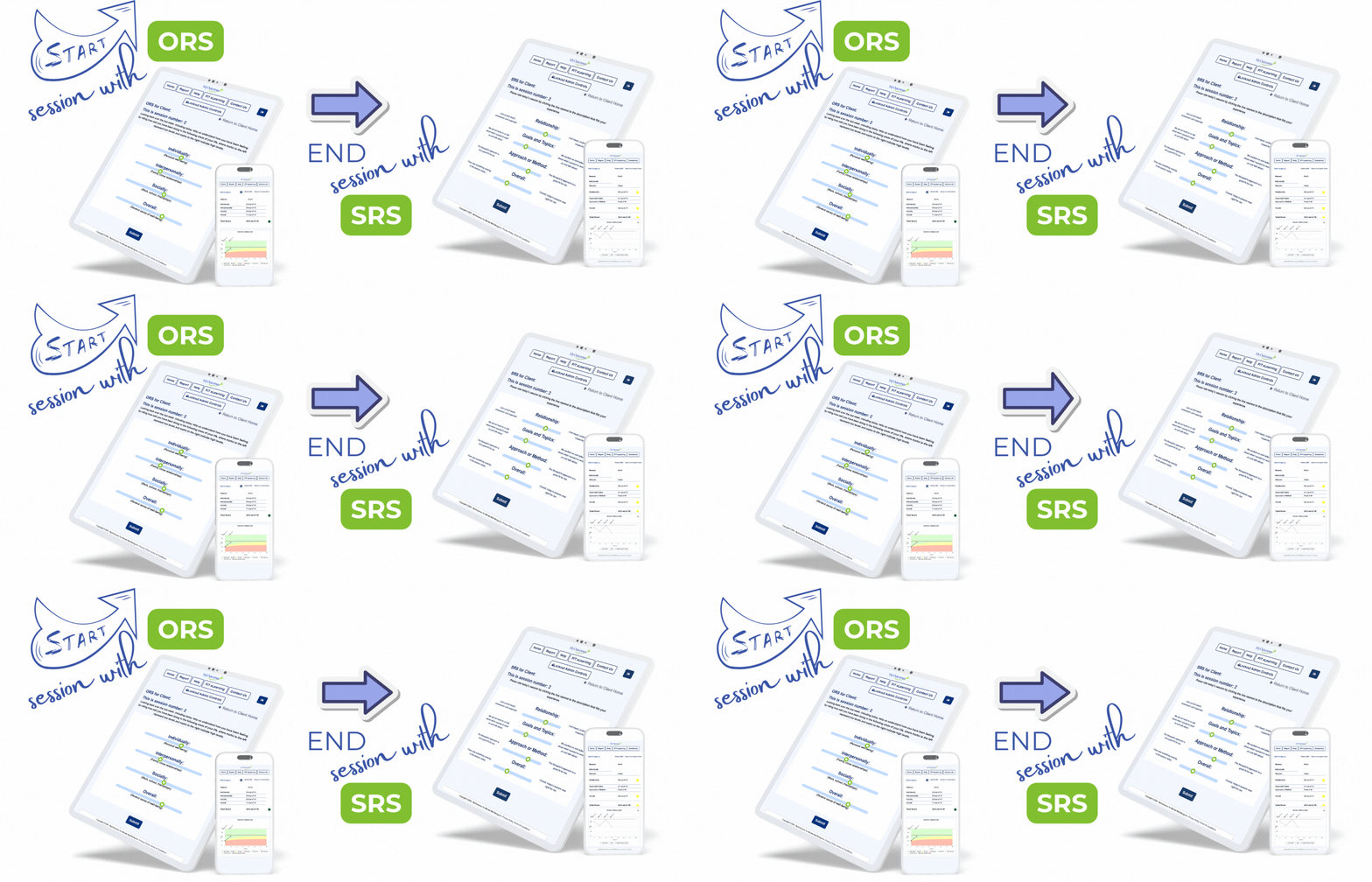
Here’s how you can bring evidence-based feedback into your practice:
- Start sessions with ORS:
Have clients quickly rate how they’re feeling about life and progress. This opens dialogue about readiness and well-being. - End sessions with SRS:
The SRS allows clients to rate their experience of the session and the relationship. Reviewing these ratings together supports open communication and strengthens the alliance. - Use MyOutcomes for Reliable Session-to-Session Tracking:
MyOutcomes is purpose-built for Feedback-Informed Treatment. It collects, stores, and visualizes ORS and SRS feedback, providing clear trends and alerts that help therapists and organizations monitor alliance and outcomes in real time. - Discuss feedback collaboratively:
Example: “You rated our goals lower this week — tell me what changed.” This normalizes feedback and encourages honesty. - Revisit goals regularly:
Adapt treatment based on feedback, reinforcing client ownership and strengthening the alliance.
Learn more: MyOutcomes – Manuals for Successful Implementation myoutcomes.com
Therapists who consistently use feedback-informed care report stronger relationships and greater clinical success. Clients, in turn, describe feeling empowered, seen, and respected — the heart of any effective therapeutic alliance.
<pstyle=”text-align:justify;”>That’s what feedback does: it turns passive clients into active participants. When clients co-own their journey, therapeutic outcomes and alliances both improve.
</pstyle=”text-align:justify;”>
If you’re ready to turn evidence into practice, MyOutcomes is more than a tool — it’s a partner in feedback-informed therapy (FIT).
Here’s what makes it stand out:
- Quick and intuitive SRS/ORS feedback for every client, every session.
- Real-time analytics to monitor alliance, outcomes, and engagement.
- Customizable dashboards to fit your practice or organization’s needs.
- Proven performance — trusted by 15+ universities, the U.S. Military, and professionals in 26 countries.
- HIPAA, PIPEDA & GDPR-compliant, and secure.
- Rsearch-backed for maximum confidence.
- With MyOutcomes, feedback becomes the foundation of a stronger therapeutic partnership.
Explore more: Why Feedback-Driven Platforms Work – MyOutcomes
- Flückiger, C., et al. (2012). Journal of Counseling Psychology, 59(1), 18–26.
- Douglas, S., et al. (2015). Using Progress Feedback to Enhance Treatment Outcomes. NIH.
- Prescott, D. S., Maeschalck, C., & Miller, S. D. (2017). Feedback-Informed Treatment in Clinical Practice: Reaching for Excellence. American Psychological Association. https://www.jstor.org/stable/j.ctv1chs647
- Miller, S. D. (2019). “Feedback Informed Treatment.” In Handbook of Psychotherapy Integration (3rd ed.). https://doi.org/10.1093/med-psych/9780190690465.003.0005
- Del Río Olvera, F. J., et al. (2022). Frontiers in Psychology.
- Lambert, M. J., Hansen, N. B., & Finch, A. E. (2001). Psychotherapy Research.