
In mental health care, timing is everything. A small insight discovered at the right moment can prevent dropout, repair the alliance, improve engagement, and completely reshape the direction of therapy.
To improve therapeutic outcomes, clinicians who use measurement-based care tools. Not all measures are designed to assess therapeutic alliance and client care perspectives. That is why we feature the use of the Outcome Rating Scale (ORS) and Session Rating Scale (SRS). These 4-point measures are science-backed indicators that feed into MyOutcomes’ predictive algorithm, producing an outcome trajectory rating and a session-by-session indicator of client progress called the Success Probability Index (SPI).
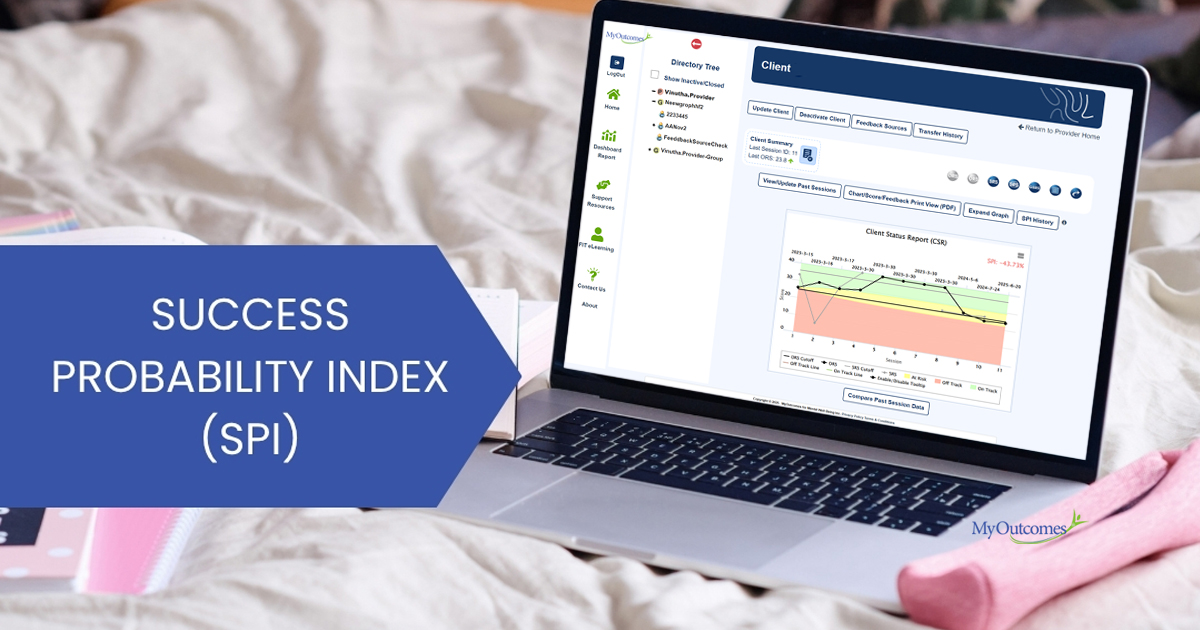
The Success Probability Index (SPI) is a dynamic, session-by-session prediction tool that analyzes current and past ORS and SRS scores to estimate the client’s likelihood of a successful. It was developed by a team of researchers led by Dr. Scott D. Miller.
The SPI can be used to assess:
- Is the client on a path that will likely lead to meaningful change?
- Are there early signs of risk I should address now?
- Do we need to adjust our direction sooner rather than later?
A prediction is stated as a colour-coded percentage in relation to the dataset mean of zero at that session.
Simply this means:
🟢 Green: Positive progress — treatment approach is working
🟡 Yellow: Little change — good moment to reflect
🔴 Red: Progress slowing — early opportunity to adjust treatment
SPI acts like a GPS for therapy — giving you a clearer, session-by-session sense of how therapy is progressing and when small adjustments can help clients stay on track.
It Predicts Progress Before Problems Become Visible
- Lack of improvement
- Slowing gains
- Alliance fluctuations
- Emotional disengagement
- Irregular progress patterns
Because SPI updates every session, clinicians get immediate feedback when something shifts.
It Strengthens the Therapeutic Alliance
- How did this week feel for you?
- Is there something you want us to focus on more?
- Does anything about our work feel off track to you?
This improves trust, transparency, and engagement — the strongest predictors of outcomes.
It Helps Agencies Improve Quality Across Their Whole Team
- Early visibility into at-risk cases
- Actionable patterns for improvement
- Stronger evidence for quality assurance
- Data-driven supervision and coaching
- Increased engagement and reduced dropout
- Clearer reporting and accountability
Why SPI Is Better Than Traditional Feedback Alone
SPI converts raw scores into meaningful predictions, making therapy clearer and more intentional.

Scenario 1: Green → Yellow
Scenario 2: Yellow → Green
Scenario 3: Red Signal
SPI supports better care by helping therapists:
- ✓ Personalize direction
- ✓ Notice small, important change
- ✓ Strengthen engagement
- ✓ Validate client experiences
Clients feel:
- ✓ Heard
- ✓ Guided
- ✓ Supported
- ✓ Confident in the process
Why Agencies Choose SPI
Organizations using SPI see:
- ✓ Better client engagement
- ✓ More consistent outcomes
- ✓ Lower dropout rates
- ✓ Stronger supervision
- ✓ Improved reporting
- ✓ Better program-wide performance
The Success Probability Index helps clinicians and agencies:
- Predict outcomes earlier
- Strengthen the alliance
- Improve treatment quality
- Personalize care
- Make decisions based on evidence, not guesswork
SPI does not replace clinical expertise — it enhances it.
- For therapists, SPI is guidance.
- For clients, SPI is safety.
- For agencies, SPI is clarity.
And for MyOutcomes users, it is one of the most valuable tools in modern evidence-based care.
To learn more and understand how to adapt SPI and Measurement Based Care in your practice,
book a 20 min session with us.
For more details watch Dr. Scott D. Miller explain the SPI in this video Success Probability Index (SPI)
Read: www.scottdmiller.com/the-success-probability-index-spi/