
Therapists want to know whether their work is helping clients move toward meaningful change. While clinical intuition is valuable, research shows that relying on intuition alone can make it difficult to detect when therapy is not progressing as expected.
Feedback-Informed Treatment (FIT) is an evidence-based approach that helps therapists track client progress and strengthen the therapeutic alliance using structured feedback collected during therapy.
By routinely measuring outcomes and session experience, FIT allows therapists to make informed adjustments that improve engagement, reduce dropout, and enhance treatment effectiveness.
Feedback-Informed Treatment (FIT) is a therapeutic approach that integrates regular client feedback into the therapy process to guide clinical decision-making.
The model was developed through the work of researchers such as Scott D. Miller, Barry Duncan, and colleagues, who demonstrated that systematic feedback improves therapeutic outcomes and strengthens the therapeutic alliance.
Rather than waiting until therapy ends to evaluate progress, FIT encourages therapists to collect feedback during treatment, allowing adjustments to be made in real time.
This approach helps therapists answer two essential questions:
- Is the client improving?
- How is the therapeutic relationship working for the client?
Research consistently shows that the therapeutic alliance—the collaborative relationship between therapist and client—is one of the strongest predictors of successful outcomes.
However, therapists often struggle to detect when the alliance is weakening or when progress has stalled. Clients may hesitate to express dissatisfaction directly, and therapists may unintentionally overlook subtle signals.
Feedback-Informed Treatment addresses this challenge by introducing structured tools that make client perspectives visible.
When therapists regularly review client feedback:
- non-responding clients can be identified earlier
- treatment strategies can be adjusted more effectively
- clients feel more involved in their care
- dropout rates decrease
Studies have found that therapists who integrate client feedback into treatment can significantly improve outcomes compared to those who rely solely on clinical judgment.
Feedback-Informed Treatment is commonly implemented using two brief measures that capture essential information about therapy progress.
The Outcome Rating Scale (ORS) measures a client’s overall well-being and functioning.
Clients rate how they have been doing across several areas of life, including:
- personal well-being
- relationships
- social functioning
- overall life satisfaction
Tracking ORS scores across sessions helps therapists identify whether clients are improving or experiencing difficulties that require attention
Learn more about the Outcome Rating Scale (ORS).
The Session Rating Scale (SRS) measures the client’s experience of the therapy session and the therapeutic relationship.
It focuses on areas such as:
- the strength of the therapeutic alliance
- whether the session addressed the client’s concerns
- how well the therapist’s approach fit the client’s needs
- the client’s overall experience of the session
Reviewing SRS feedback helps therapists identify alliance ruptures early and repair them before they impact treatment outcomes.
Learn more about the Session Rating Scale (SRS).
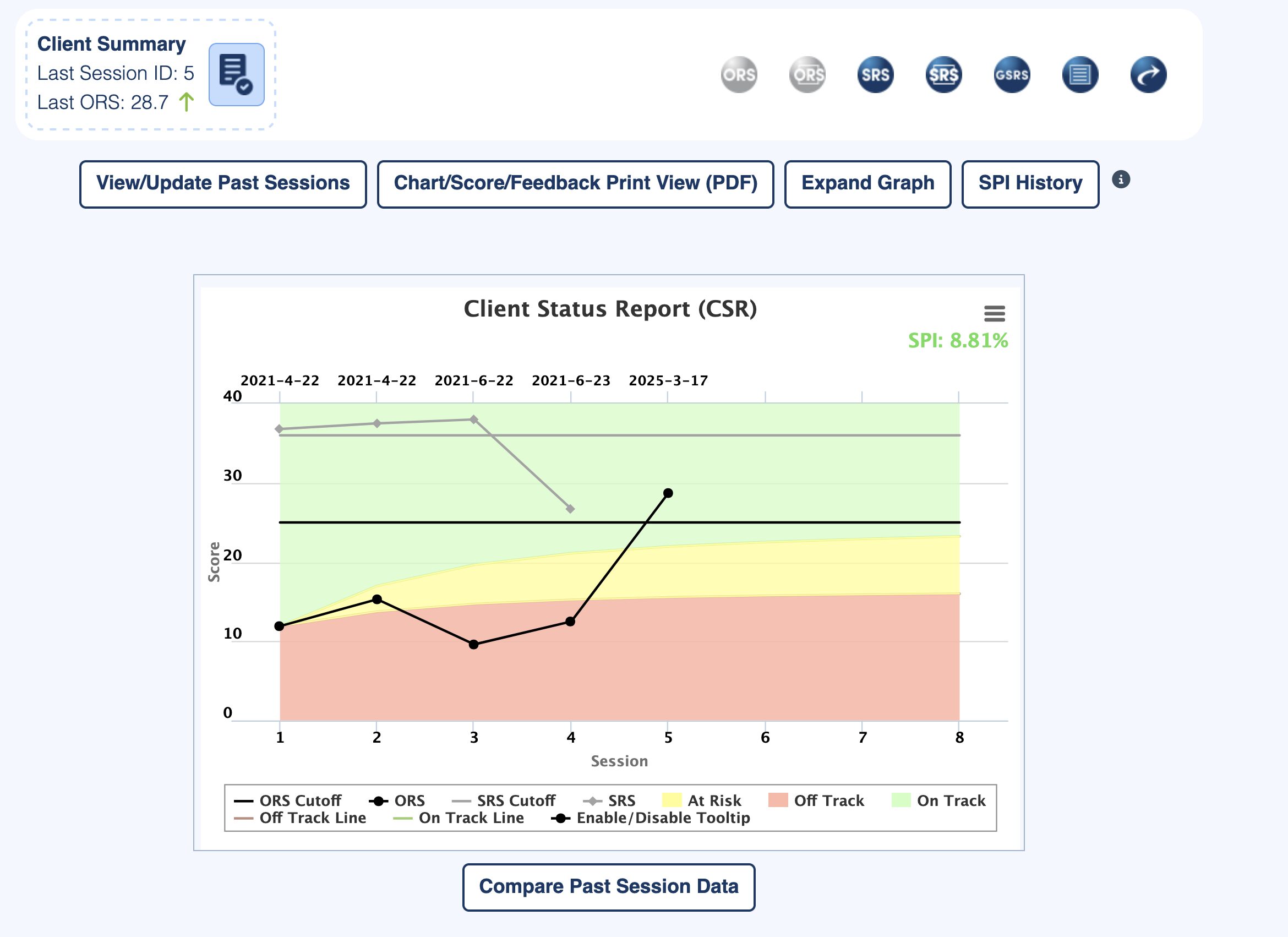
Feedback-Informed Treatment is simple to integrate into therapy sessions.
A typical process may look like this:
This ongoing feedback loop helps ensure therapy remains responsive to the client’s needs.
Feedback-Informed Treatment is closely aligned with the broader concept of Measurement-Based Care (MBC).
Measurement-Based Care involves the routine use of validated assessment tools to monitor treatment progress and inform clinical decisions.
While MBC may include a wide range of assessments such as:
- PHQ-9 for depression
- GAD-7 for anxiety
- OASIS for anxiety severity
FIT focuses specifically on client-reported feedback about outcomes and the therapeutic alliance.
Together, these approaches help therapists move toward more transparent, collaborative, and data-informed care.
MyOutcomes® was designed to make Feedback-Informed Treatment easy to implement in everyday clinical practice.
Using MyOutcomes, therapists can:
- administer ORS and SRS digitally before or after sessions
- automatically calculate and track scores
- view clear visual trends across sessions
- identify clients who may not be improving
- strengthen therapeutic alliance through structured feedback
The platform allows therapists to integrate feedback seamlessly without adding administrative burden.
By making client feedback visible and accessible, MyOutcomes helps clinicians stay focused on what matters most—supporting meaningful client progress.
Therapists who integrate FIT into their practice often report several benefits:
- improved treatment outcomes
- stronger therapeutic alliances
- earlier detection of treatment non-response
- increased client engagement
- greater transparency in the therapy process
Clients also benefit from having their perspectives actively incorporated into treatment decisions.
Feedback-Informed Treatment is an evidence-based approach that uses structured client feedback to monitor therapy progress and improve outcomes.
FIT commonly uses two brief measures: the Outcome Rating Scale (ORS) and the Session Rating Scale (SRS).
Research indicates that incorporating regular client feedback into therapy can improve outcomes and reduce dropout rates.
Feedback-Informed Treatment is a client-focused form of Measurement-Based Care that emphasizes ongoing feedback about progress and the therapeutic relationship.
Therapy works best when it remains responsive to the client’s experience. Feedback-Informed Treatment provides a structured way to ensure that therapy stays aligned with the client’s needs and goals.
By combining the principles of FIT with the digital tools provided by MyOutcomes®, therapists can create a feedback-rich environment that supports stronger alliances, clearer progress tracking, and better outcomes for the people they serve.
Miller, S. D., Duncan, B. L., Sorrell, R., & Brown, J. (2005).
The Partners for Change Outcome Management System.
Journal of Clinical Psychology.
Duncan, B. L., & Miller, S. D. (2008).
The Outcome and Session Rating Scales: The Revised Administration and Scoring Manual.
Lambert, M. J., & Shimokawa, K. (2011).
Collecting client feedback.
Psychotherapy.