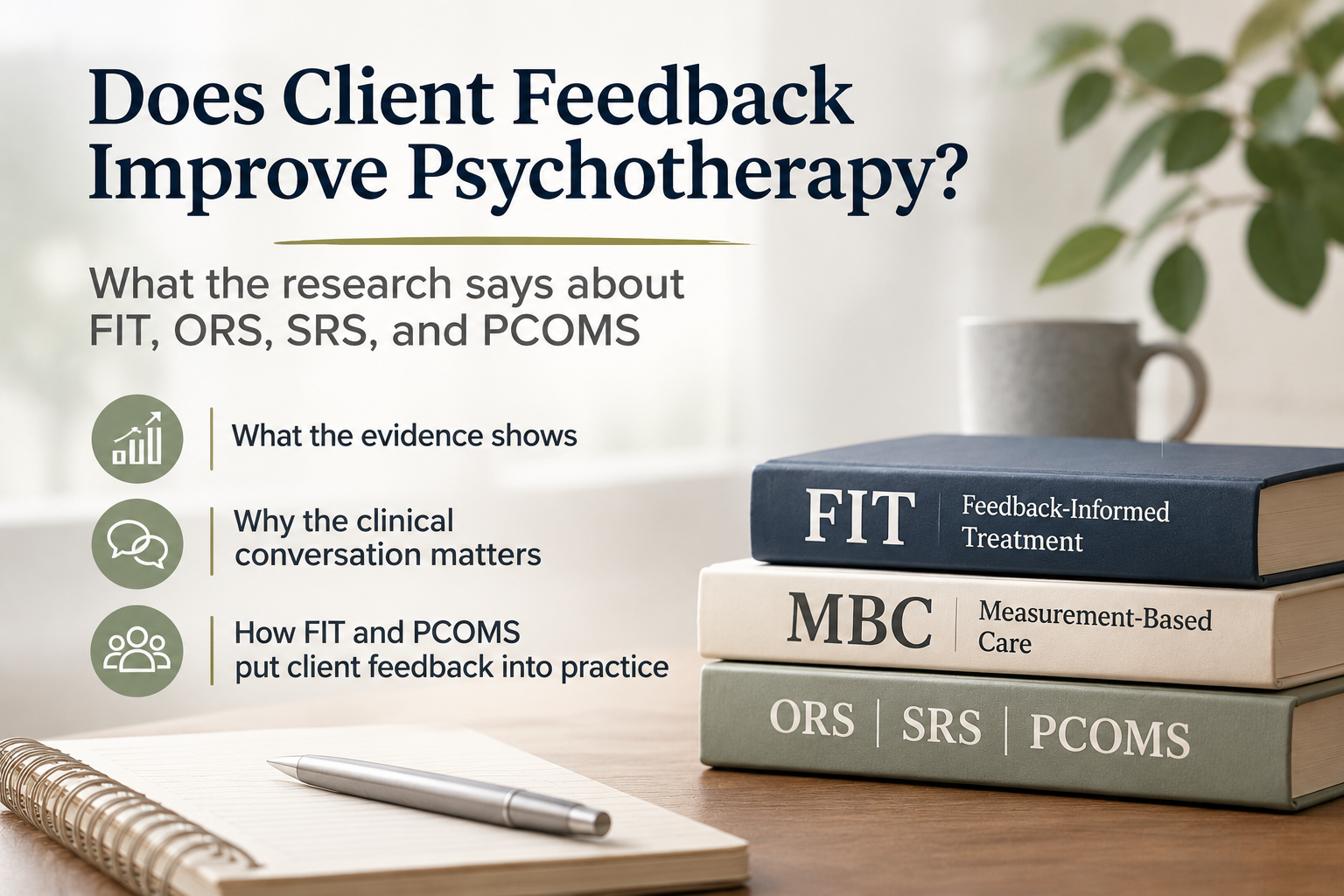
What the research says about FIT, ORS, SRS, and PCOMS
Summary from Daryl Chow’s article: What’s the Evidence for Feedback-Informed Treatment (FIT)
The peer-reviewed meta-analysis: peer-reviewed meta-analysis
Related video: Wait, Why Measure?
Feedback tools can help clinicians notice whether a client is improving and whether the work together feels useful. But a questionnaire does not improve therapy on its own. The benefit depends on what happens next: whether the clinician and client look at the feedback together, make sense of it, and use it to guide care.
That is the practical idea behind Feedback-Informed Treatment (FIT). It combines regular client feedback with a collaborative conversation, keeping the client’s experience in view as treatment unfolds.
What does the evidence show?
In his article “What’s the Evidence for Feedback-Informed Treatment (FIT),” psychologist and researcher Daryl Chow discusses a large multilevel meta-analysis by Kim de Jong and colleagues. The analysis included 58 studies and 21,699 clients. Across the studies, progress feedback was associated with a small average improvement in symptoms and a favorable effect on dropout rates.
The average effect on symptoms was modest. That matters: it suggests feedback can add value, but it is not a stand-alone treatment and cannot guarantee that every client will improve. The researchers also found no significant overall effect on the number of sessions or on the rate of deterioration. In the control groups, 5.4% of clients deteriorated compared with 4.6% in feedback groups; that difference was not statistically significant.
The message is encouraging and measured. Routine feedback may improve outcomes on average and may help reduce dropout, while the size of the benefit varies by client, clinician, setting, and how feedback is used.
Why the conversation matters
A score is a signal, not an explanation. A lower rating might reflect a difficult week, a change in circumstances, slow progress, or a concern the client has not yet voiced. The clinician needs to ask and listen before deciding what the score means.
This is why FIT is more than collecting data. The clinician brings the feedback into the session, invites the client’s interpretation, and considers whether to continue, adjust, or revisit the plan. Training can help clinicians use feedback thoughtfully; Chow notes that studies involving therapist training showed larger effects in reducing deterioration than studies without such training, even though the meta-analysis found no significant overall reduction in deterioration.
ORS, SRS, and PCOMS
The Outcome Rating Scale (ORS) gives clients a brief way to report how they are doing in areas such as personal well-being, relationships, and daily functioning. The Session Rating Scale (SRS) asks how the client experienced the session, including the relationship, goals, approach, and overall fit.
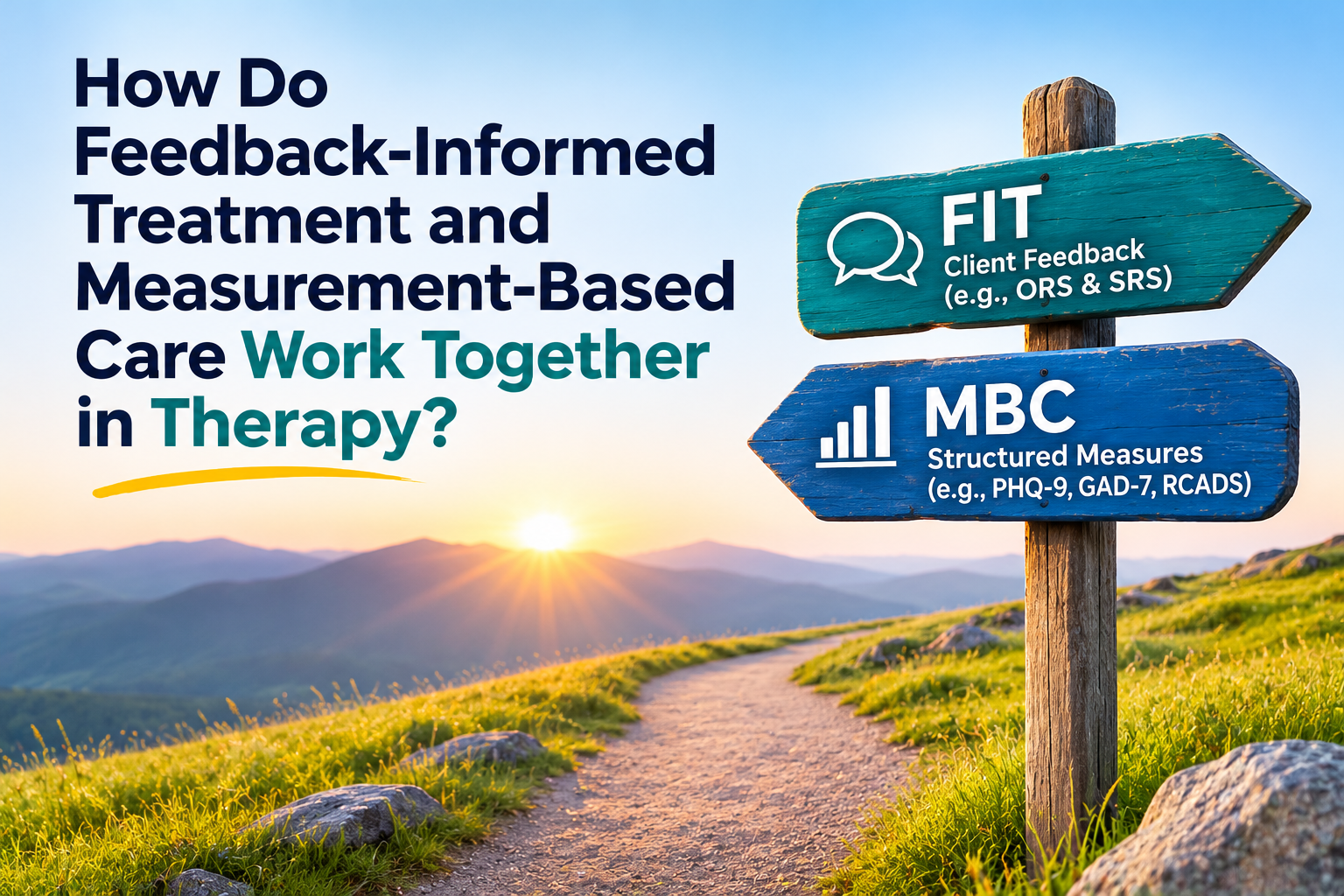
The ORS and SRS are central to PCOMS—the Partners for Change Outcome Management System. FIT and PCOMS share this foundation of routine client feedback. FIT describes the broader practice of using feedback to inform care, while PCOMS is a specific system built around the ORS and SRS. Research discussed in Chow’s article reports differences between feedback systems, but those comparisons should be interpreted carefully; they do not establish that one platform or brand is universally superior.
Turn feedback into a next step
- Collect the client’s progress feedback and session feedback regularly.
- Review the results together instead of treating them as a scorecard.
- Ask what the client thinks the pattern means and what may be missing.
- Agree on whether to continue the current approach or make an adjustment.
- Check the feedback again to learn whether the change helped.
This routine gives the client a clearer role in shaping treatment and gives the clinician another source of information alongside clinical judgment, the client’s goals, and the wider context of their life.
How MyOutcomes can support FIT
MyOutcomes supports digital ORS and SRS workflows, progress tracking, trajectory indicators, and the Success Probability Index (SPI). These tools can help clinicians and supervisors notice patterns, review cases, and bring timely questions into sessions or supervision. The indicators are prompts for clinical attention, not diagnoses or automatic treatment decisions.
The research described above evaluates progress feedback across studies and systems; it is not a product-specific trial of MyOutcomes or its SPI. The strongest, most defensible case for using a platform is that it can make regular feedback and review easier to carry out consistently. Its value still depends on clinicians discussing the feedback and responding to clients.
FIT is not measurement for measurement’s sake. It is a repeatable way to ask clients how they are doing, find out how the work is landing, and use what they say to shape the next step. The evidence supports a modest potential benefit, while reminding us that feedback works best when it leads to a real clinical conversation.