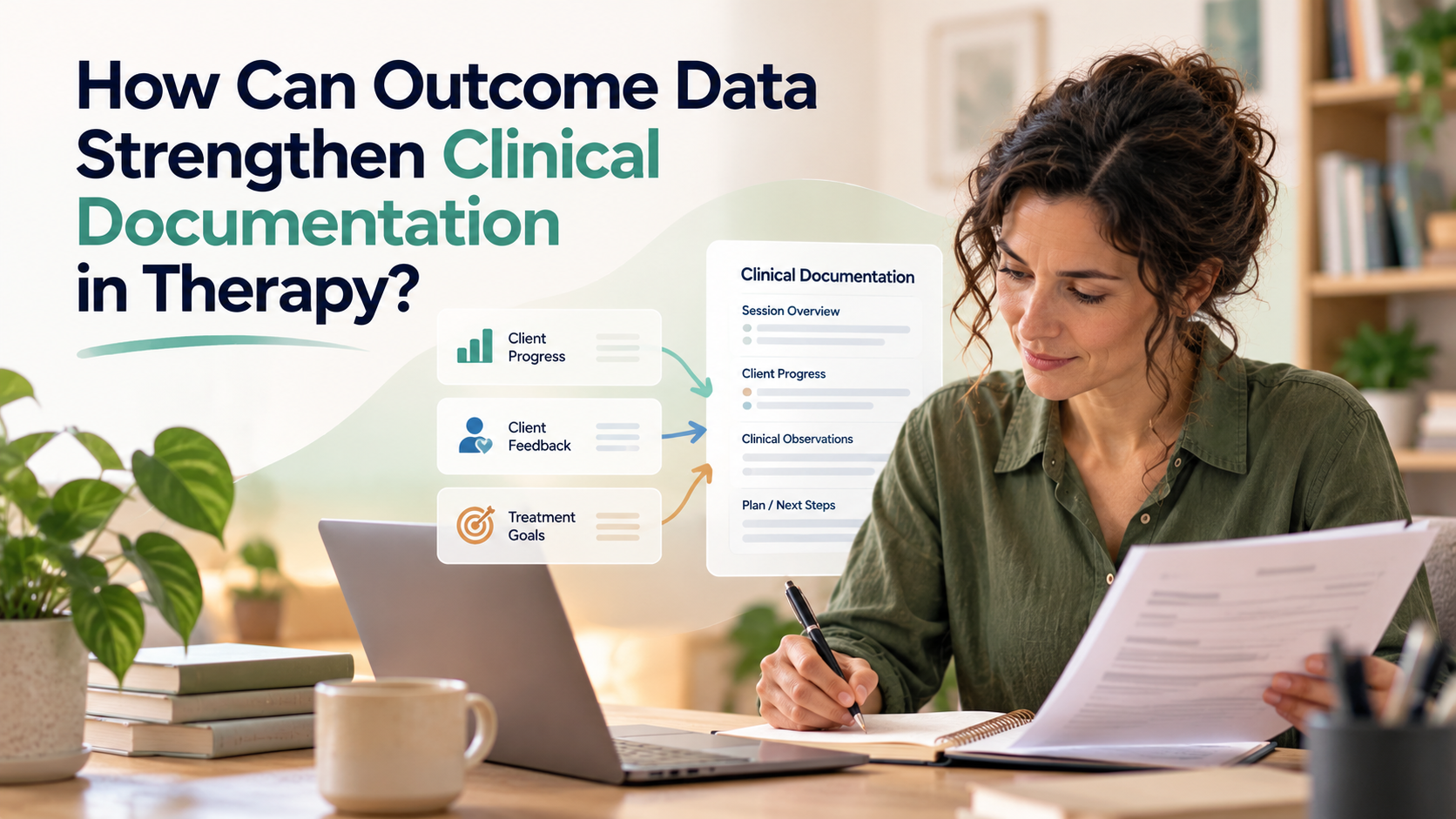
Clinical documentation helps therapists keep track of client progress, treatment goals, clinical observations, and important developments throughout care.
Outcome data can add another useful perspective by showing how a client’s reported progress and experience change over time.
When used alongside clinical observations, client conversations, and professional judgment, outcome information can help therapists create a clearer picture of the therapeutic process without turning documentation into a collection of numbers.
What Role Does Outcome Data Play in Clinical Documentation?
Clinical documentation captures what happens during therapy and the reasoning behind ongoing care. Outcome data can complement this by providing structured information about the client’s experience and progress.
For example, a therapist may observe that a client is making progress. Repeated outcome information can provide additional context by showing whether that change is part of a broader pattern across several sessions.
The outcome measure does not replace the therapist’s clinical observations. Instead, it gives the therapist another source of information to consider when documenting progress and treatment decisions.
How Can Outcome Data Help Therapists Document Client Progress?
Progress in therapy is rarely limited to a single moment.
A client may experience gradual improvement, periods of slower change, or shifts in different areas of their life. Repeated outcome information can make some of these patterns easier to see.
Instead of relying only on a general statement such as “the client is progressing,” therapists can consider how the client’s reported outcomes have changed over time and connect that information with what was discussed and observed during sessions.
This can make documentation more specific while keeping the client’s experience visible.
Can Outcome Measures Support Progress Notes?
Outcome data should not replace the narrative and clinical reasoning contained in a progress note.
Instead, it can provide supporting context.
When reviewing an outcome measure, a therapist might consider:
- What did the client report?
- How does this compare with previous sessions?
- What did the client say about the change?
- What was discussed during the session?
- Did the information influence the focus or direction of care?
The goal is not to document every score. It is to record information that is clinically meaningful.
How Can Outcome Data Support Treatment Planning?
Treatment plans can change as therapy progresses. A client’s priorities may shift, goals may evolve, or new concerns may emerge.
Outcome information can provide another reference point when reviewing whether the current direction of treatment continues to reflect the client’s needs.
For example, if outcome information suggests improvement in one area while another remains relatively unchanged, the therapist and client may choose to explore whether treatment priorities should be revisited.
The data does not determine the treatment plan. It can help support a more informed conversation about what comes next.
How Can Outcome Data Show Change Over Time?
One of the main benefits of repeated outcome measurement is the ability to look beyond a single session.
A single result provides a snapshot. A series of results can reveal a pattern.
That pattern might show gradual improvement, limited change, or a noticeable shift that deserves further discussion.
This longitudinal perspective can be particularly useful when documenting progress because it connects the current session with the broader treatment journey.
This is closely related to session-by-session outcome monitoring, where information is gathered throughout therapy to help make changes over time more visible.
What If Outcome Data Does Not Match the Therapist's Observation?
Outcome data and clinical observation will not always tell the same story.
A therapist may observe increased engagement or confidence while a client’s reported outcome has changed very little. Conversely, a client may report improvement that is not immediately obvious to the therapist.
Rather than treating one source as more correct than the other, the difference can become a reason to explore the client’s experience further.
The documentation can then reflect both the available outcome information and the clinical context surrounding it.
This is one reason outcome data works best as one part of clinical reasoning rather than a standalone conclusion.
Does Outcome Data Replace Clinical Judgment?
No.
Outcome measures provide structured information, but they cannot capture every factor that influences therapy.
A useful clinical record brings together several perspectives:
The purpose is not to replace clinical expertise with measurement. It is to give clinicians another source of information to consider.
How Does Outcome Data Fit With Measurement-Based Care?
Measurement-Based Care (MBC) involves using structured information throughout treatment to support clinical understanding and decision-making.
Clinical documentation can be one place where that information becomes part of the wider care process.
The measure provides information. The clinical conversation provides context. Documentation records the relevant clinical understanding and decisions.
This helps connect outcome measurement with the broader process of care rather than treating it as a separate administrative task.
How Does This Connect With Feedback-Informed Treatment?
Feedback-Informed Treatment (FIT) emphasizes using client feedback to inform the therapeutic process.
When feedback provides useful insight into the client’s experience, documenting the relevant discussion or clinical response can help maintain the connection between feedback, reflection, and action.
The important step is not simply recording that a measure was completed.
It is understanding whether the information contributed meaningfully to the therapeutic conversation or treatment process.
For more on using client feedback throughout therapy, see How to Close the Feedback Loop in Therapy.
What Should Therapists Keep in Mind When Documenting Outcome Data?
Outcome data is most useful when it remains connected to the client and the purpose of care.
Therapists can keep a few principles in mind:
Use data in context. A score or trend rarely explains itself.
Look for meaningful patterns. Repeated information can provide more context than an isolated result.
Keep the client perspective visible. Measurement provides information; conversation provides meaning.
Document what is clinically relevant. Not every score needs to become part of the narrative.
Use professional judgment. Outcome data supports clinical reasoning; it does not replace it.
Final Thoughts
Clinical documentation and outcome measurement do not need to exist as separate parts of therapy.
When used thoughtfully, outcome data can provide useful context for documenting client progress, treatment discussions, changing goals, and patterns across sessions.
The goal is not to add more numbers to the clinical record.
It is to make meaningful information about the client’s experience easier to see, understand, and connect with the clinical work.
When outcome data, client feedback, clinical observation, and professional judgment come together, documentation can provide a clearer picture of the therapeutic journey.