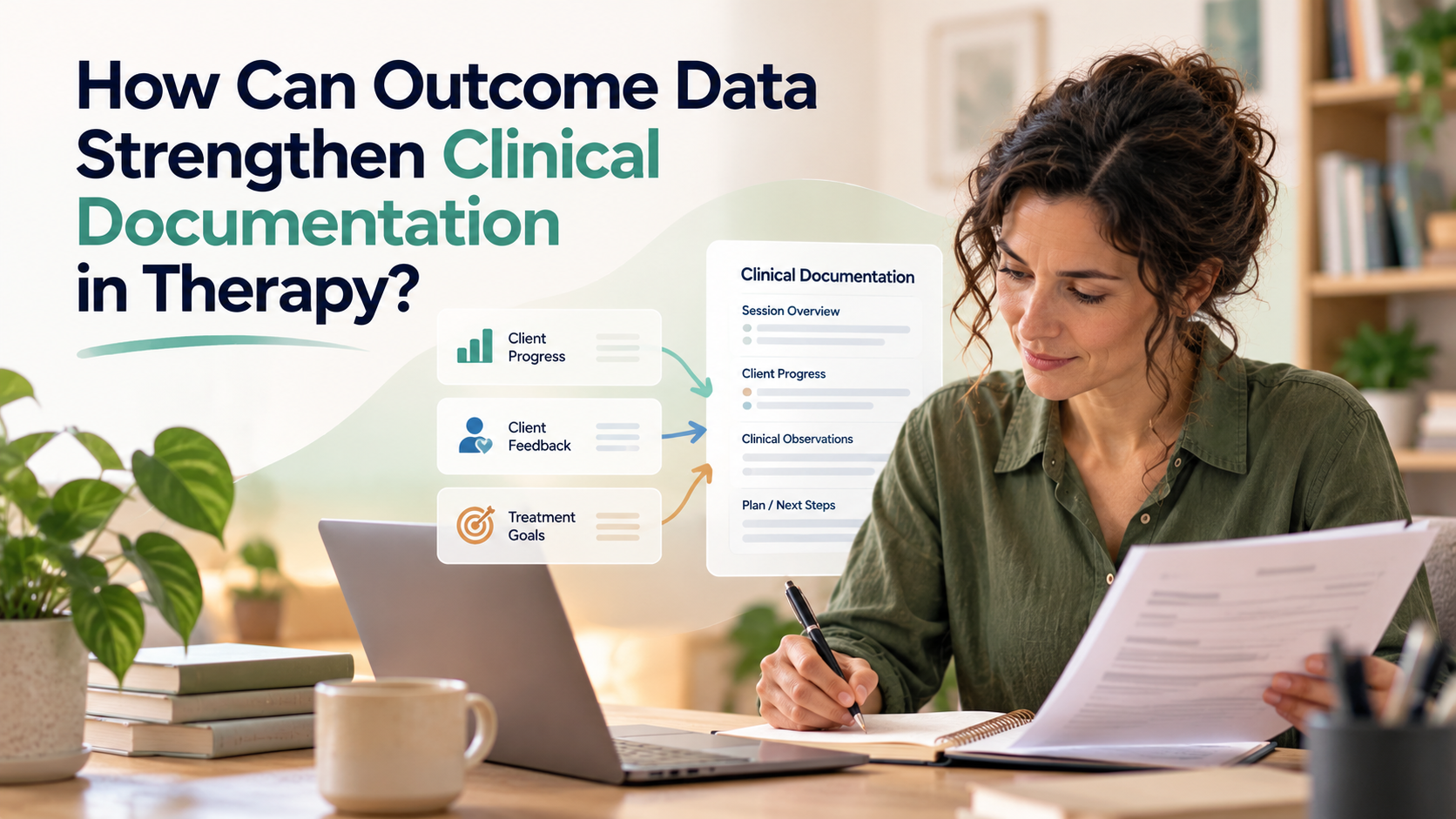
Therapists use many types of information to understand client progress and make informed decisions throughout therapy. Clinical observations, client conversations, standardized assessments, treatment goals, and ongoing feedback can all contribute to that understanding.
Two approaches that frequently appear in conversations about outcome measurement are Feedback-Informed Treatment (FIT) and Measurement-Based Care (MBC).
They are sometimes treated as though therapists need to choose one or the other. In practice, they can work together.
Measurement-Based Care provides a broader framework for using structured clinical information, while Feedback-Informed Treatment places particular emphasis on using regular client feedback to understand progress and the therapeutic relationship.
Understanding how these approaches complement each other can help therapists and mental health organizations develop a more practical approach to outcome measurement.
What Is Measurement-Based Care in Mental Health Therapy?
Measurement-Based Care involves using structured information about a client’s symptoms, functioning, progress, or experience to support clinical understanding and treatment decisions.
The information can come from different standardized assessment tools depending on the clinical question. A therapist might use a depression or anxiety measure to understand symptom severity, for example, while other measures may focus on broader functioning or treatment outcomes.
The important part is what happens with the information.
MBC is most useful when measurement is connected to clinical review and decision-making rather than treated as a separate data-collection task. MyOutcomes describes MBC as a process of selecting, collecting, reviewing, and acting on structured information throughout care.
What Is Feedback-Informed Treatment and How Does It Use Client Feedback?
Feedback-Informed Treatment focuses on using regular feedback from clients to inform the therapeutic process.
In FIT, the therapist and client can use structured feedback to explore two important areas: how the client is doing and how the therapy is going.
The Outcome Rating Scale (ORS) provides information about the client’s perception of progress and wellbeing, while the Session Rating Scale (SRS) gathers feedback about the therapeutic relationship and session experience.
The purpose is not simply to administer the measures.
The information becomes useful when it is discussed with the client and considered alongside clinical expertise and the broader context of therapy.
How Are FIT and MBC Different in Clinical Practice?
The easiest way to understand the relationship is to look at their scope.
MBC is the broader measurement approach.
FIT is a specific feedback-informed approach that uses routine client feedback within therapy.
MBC can involve different types of standardized assessments and clinical measures. FIT places a stronger emphasis on making client feedback part of the ongoing therapeutic conversation.
This means FIT can operate within a broader MBC strategy.
A practice might use several validated assessment tools to monitor specific clinical concerns while also using ORS and SRS to understand the client’s broader experience and feedback about therapy.
The two approaches can therefore answer different questions without competing with each other.
How Can FIT and MBC Work Together in Everyday Therapy?
Consider a client receiving therapy for anxiety.
A therapist might use a symptom-specific anxiety measure to monitor changes in anxiety severity over time. At the same time, the therapist could use the ORS to understand the client’s broader perception of wellbeing and progress and the SRS to gather feedback about the therapy session.
Each source provides a different perspective.
The symptom measure may help answer: “How are the client’s anxiety symptoms changing?”
The ORS may help explore: “How does the client perceive their overall functioning and wellbeing?”
The SRS may help explore: “How is the client experiencing the therapy and therapeutic relationship?”
The value comes from considering these perspectives together rather than expecting one measure to answer every clinical question.
How Can Different Outcome Measures Complement Each Other?
Not every measure is designed to measure the same thing.
A symptom-specific assessment may provide detailed information about a particular clinical concern. A broader outcome measure may provide information about the client’s overall perception of change. A session feedback measure can provide information about the therapeutic relationship and the client’s experience of the session.
This means differences between measures are not necessarily a problem.
They can provide useful information.
For example, a client may report that anxiety symptoms have improved while their broader sense of wellbeing has changed very little. Rather than deciding that one measure must be correct, the therapist can explore what the difference means for the client.
This builds on the questions explored in When ORS and Symptom Measures Tell Different Stories.
Why Is Client Feedback Important in Measurement-Based Care?
Structured measurement can tell a therapist that something has changed. The client can often provide important context about what that change means.
For example, an improvement in a measure may reflect changes in relationships, work, daily functioning, confidence, or another area that matters to the client.
Similarly, limited measurable change may prompt a conversation about whether the current goals still reflect the client’s priorities.
This is where FIT adds an important client-feedback perspective to measurement-based practice.
The therapist is not simply reviewing information independently.
The client has an opportunity to help interpret what the information means within their own life.
Can Measurement-Based Care Be Used Without Making Therapy Feel Like Data Collection?
Yes.
The experience of measurement depends heavily on how it is integrated into therapy.
When measures are presented as isolated forms to complete, clients may see them as another administrative requirement. When the purpose is clear and the information is brought back into the therapeutic conversation, measurement can become more meaningful.
A useful question for therapists is not simply: “Did we collect the measure?”
It is: “What can we learn from this information?”
That shift keeps outcome measurement connected to clinical conversations rather than allowing it to become a task that sits outside the therapy process.
This principle also connects with How to Introduce Outcome Measures to Clients: A Practical Guide for Therapists.
How Do FIT and MBC Support Clinical Decision-Making?
Neither FIT nor MBC is intended to make clinical decisions automatically.
Instead, both can provide information that contributes to clinical reasoning.
A therapist may notice that one outcome measure shows improvement while another remains relatively unchanged. The client may have a different interpretation of the change. The therapist may also have observations that are not captured by either measure.
These perspectives can be brought together.
The questions might become:
What are we seeing?
What is the client experiencing?
What might explain the difference?
Does anything need to change?
What should we continue monitoring?
The data supports the conversation. Clinical judgment and client preferences remain essential.
How Does Session-by-Session Outcome Monitoring Fit Into MBC and FIT?
Session-by-session outcome monitoring provides a practical way to make measurement part of ongoing care.
Rather than reviewing information only at intake or at the end of treatment, therapists can gather feedback throughout therapy and look at how the client’s experience develops over time.
This can help make changes more visible and create regular opportunities to discuss progress.
It also creates a natural connection between MBC and FIT.
MBC provides a structured approach to collecting and reviewing information.
FIT emphasizes using client feedback as part of the therapeutic process.
Session-by-session monitoring can bring those ideas together in everyday clinical practice.
For a deeper explanation, see What Is Session-by-Session Outcome Monitoring in Therapy?
When Should Therapists Use Different Types of Outcome Measures?
The answer depends on the clinical question.
A therapist may choose a symptom-specific measure when they want more information about a particular concern. Broader outcome measures can provide insight into overall functioning or perceived progress. Session feedback measures can help therapists understand the client’s experience of the therapeutic process.
The goal should not be to collect as many measures as possible.
It should be to collect information that is relevant and useful.
A thoughtful measurement strategy asks:
What do we need to understand?
Which information can help us understand it?
How will we use what we learn?
This keeps measurement purposeful rather than excessive.
How Can Mental Health Practices Build an Integrated Outcome Measurement Approach?
For a growing therapy practice, integrating FIT and MBC does not necessarily mean creating a complicated measurement system.
A practice can establish a clear foundation for:
- collecting relevant client feedback;
- using appropriate standardized assessments;
- reviewing information regularly;
- discussing meaningful patterns with clients;
- supporting informed clinical decisions;
- monitoring outcomes across services where appropriate.
The exact approach can vary depending on the size of the organization, the population being served, and the goals of the practice.
The important principle is consistency of purpose: collect information that matters and make sure it can inform care.
This connects naturally with How Growing Therapy Practices Can Use Outcome Data.
What Role Does Clinical Judgment Play Alongside Outcome Data?
Clinical judgment remains central.
Outcome measures cannot capture every aspect of a client’s circumstances, goals, relationships, environment, or therapeutic experience.
They provide structured information that can complement what therapists learn through conversation, observation, assessment, and professional experience.
A useful approach is therefore not: Data versus clinical judgment.
It is: Data + client perspective + clinical expertise + context.
Bringing these sources together can provide a more informed basis for clinical conversations and decisions.
How Can FIT and MBC Create a More Connected Approach to Outcome Measurement?
FIT and MBC can be viewed as complementary parts of a broader approach to understanding therapy.
MBC provides the structure for using clinical measures and outcome information.
FIT brings a strong emphasis on routine client feedback, therapeutic alliance, and using that feedback within the therapy process.
Together, they can help therapists move from simply collecting information to using information meaningfully.
The distinction matters.
A practice can have excellent measurement systems without those measures becoming useful to clients or clinicians.
The goal is to connect measurement with conversation, reflection, and clinical action.
What Does an Integrated FIT and MBC Approach Look Like?
In practice, the process can be straightforward:
Choose relevant measures.
Select information that addresses meaningful clinical questions.
Collect information consistently.
Gather feedback at appropriate points throughout care.
Review the information.
Look at patterns rather than relying on isolated scores.
Talk with the client.
Explore what the information means from the client’s perspective.
Use clinical judgment.
Consider the data alongside professional expertise and context.
Decide what comes next.
Continue, explore, adapt, or revisit goals when appropriate.
This is not about making therapy more complicated.
It is about making useful information easier to see and use.
Where Does MyOutcomes Fit Into FIT and Measurement-Based Care?
MyOutcomes brings Feedback-Informed Treatment and broader Measurement-Based Care tools together within one platform.
The platform supports ORS and SRS-based FIT workflows alongside additional mental health assessment tools, outcome tracking, client support tools, and reporting capabilities.
This allows therapists and organizations to use structured information at different levels of care while keeping clinical judgment and client feedback central.
For individual clinicians, that can mean a practical way to monitor client progress and session feedback.
For growing organizations, it can also provide a consistent infrastructure for outcome tracking and reporting.
Final Thoughts
Feedback-Informed Treatment and Measurement-Based Care do not need to be competing approaches.
MBC provides a broader framework for using structured clinical information, while FIT places a strong emphasis on routine client feedback and using that information within the therapeutic relationship.
When combined thoughtfully, they can give therapists multiple perspectives on client progress, the therapy experience, and areas that may deserve further exploration.
The goal is not to collect more data.
It is to collect useful information, understand it in context, listen to the client’s perspective, and use what is learned to support thoughtful clinical decisions.
That is where outcome measurement becomes meaningful: when information moves beyond the measure and becomes part of the conversation about care.
Want to Bring FIT and Measurement-Based Care Together in Your Practice?
MyOutcomes helps therapists, counsellors, clinics, and mental health organizations collect client feedback, track outcomes, use assessment tools, and turn structured information into practical clinical insight.