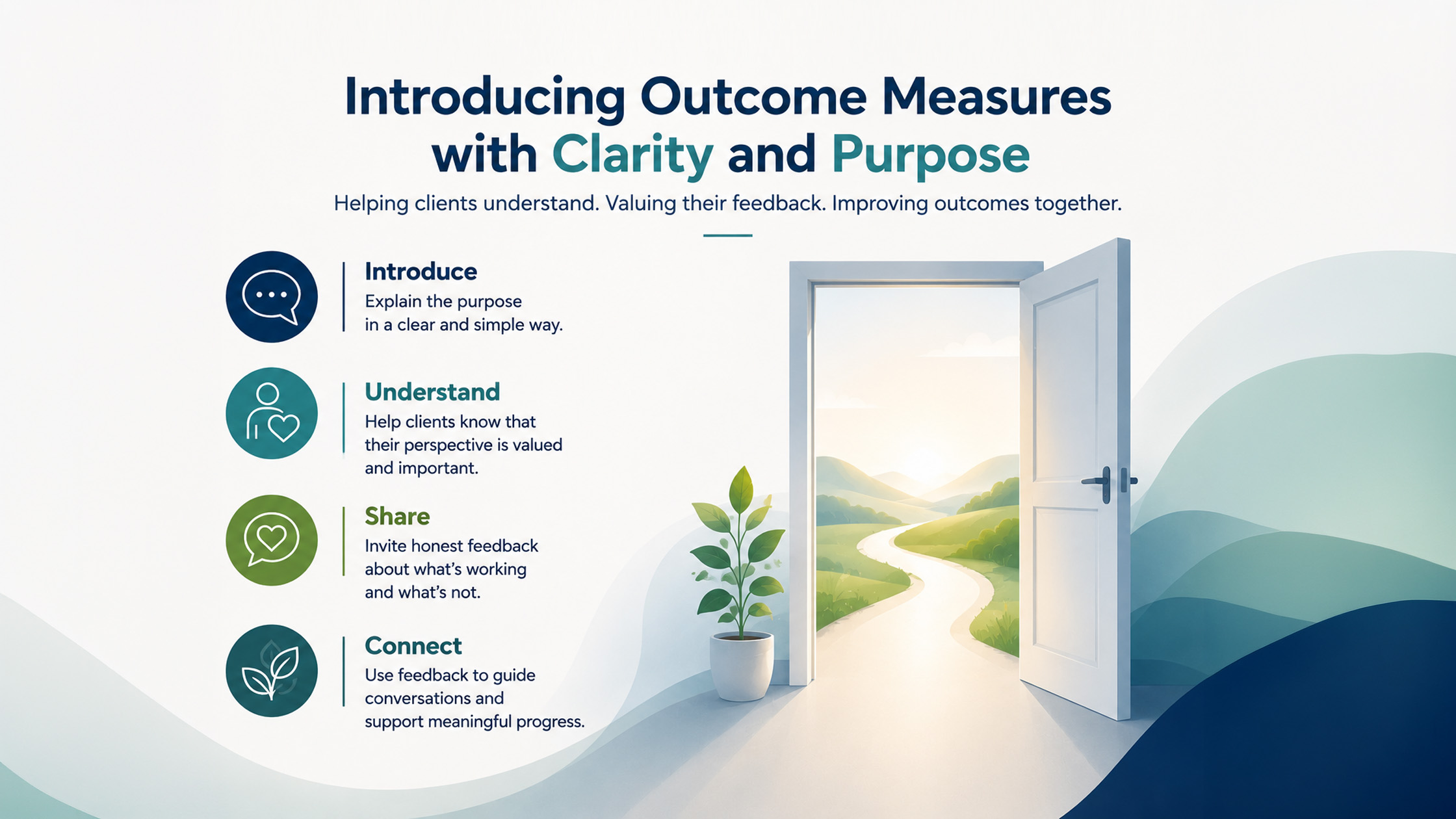
Outcome measures can provide useful information about how clients are experiencing therapy and whether treatment is moving in a helpful direction.
But before a client completes an Outcome Rating Scale, Session Rating Scale, or another therapy outcome measure, there is an important step that can influence how useful the feedback becomes:
How is the measure introduced?
If a measure is presented as another form to complete, a test to pass, or an evaluation of the therapist, clients may not understand its purpose.
When therapists explain why the measure is being used and how the information will contribute to the therapy process, it can become a natural part of the therapeutic conversation.
The goal is not to add another task to therapy.
The goal is to give clients another opportunity to communicate what they are experiencing.
Why Use Outcome Measures in Therapy?
Therapists already gather information throughout treatment.
They listen to clients, observe changes, discuss goals, review challenges, and consider how therapy is progressing.
Outcome measures provide another structured way of understanding the client’s perspective.
They can help therapists and clients:
This is one reason therapy outcome monitoring can be useful as part of routine clinical practice.
However, the measure itself is not the goal.
The goal is to use the information in a way that supports the therapeutic process.
How to Explain Outcome Measures to Clients
For example, a therapist might explain:
“This is a brief way for you to give me feedback about how things are going. Your responses can help us understand what you’re experiencing and whether there is anything we should pay more attention to.”
The exact wording does not need to be the same for every client.
The important principle is clarity.
Clients should understand that the purpose of outcome measurement is to support the therapy process, not to test them.
What Clients May Want to Know About Outcome Measures
“Why do I need to complete this?”
They may want to understand how the measure connects to their therapy. Explaining the purpose can make the process feel more meaningful.“Is this a test?”
It can be helpful to clarify that the purpose is not to judge whether the client is doing therapy correctly. Their responses provide information about their own experience.“Will my therapist judge my answers?”
Clients may hesitate to give honest feedback if they believe their responses could disappoint or offend their therapist. Creating an environment where honest feedback is welcomed is an important part of using outcome measures effectively.“What happens if my answers are negative?”
This can be an opportunity to explain that unexpected or critical feedback can be useful because it creates something that therapist and client can explore together. The aim is not to encourage positive scores. The aim is to understand the client’s experience as accurately as possible.How to Introduce the ORS at the Start of Therapy
The Outcome Rating Scale (ORS) can be introduced as a way of helping clients reflect on how they are doing across areas of their lives that are relevant to their wellbeing and functioning.
When introducing the ORS, therapists can explain how it fits into the broader therapy process.
Rather than treating it as paperwork to complete before the session begins, the therapist can frame it as an opportunity for the client to communicate where things stand.
For example: “We’ll use this regularly to help us keep track of how things are going from your perspective. It gives us another way to notice changes and talk about anything that may need attention.”
This approach keeps the focus on the client’s experience.
It also makes clear that the measure is one source of information within therapy rather than a replacement for conversation.
How to Interpret Conflicting Outcome Measure Results
The Session Rating Scale (SRS) serves a different purpose.
Rather than focusing primarily on overall progress, it provides an opportunity for clients to give feedback about their experience of the session and the therapeutic process.
This can sometimes feel more personal to clients because the feedback relates directly to their experience of working with the therapist.
A clear explanation can help.
For example: “This gives you an opportunity to tell me how today’s session felt from your perspective. If there was something that didn’t feel helpful or something you’d like us to do differently, I want to know about it.”
The important message is that honest feedback is welcome.
A lower rating is not something that needs to be defended against.
It can provide an opportunity to understand the client’s experience and consider whether anything needs to change.
How to Use Outcome Measures Without Disrupting the Therapy Session
One concern therapists may have about using outcome measures is that they could make sessions feel more administrative or interfere with the therapeutic conversation.
The way measures are integrated can make a difference.
Instead of treating the process as:
Complete → collect → record → move on therapists can integrate feedback into the flow of therapy:
Complete → notice → discuss → understand → respond
This does not mean every score needs a lengthy discussion.
Sometimes the feedback may simply confirm that things are moving in a helpful direction.
At other times, it may raise something worth exploring.
The measure becomes part of the conversation rather than a separate activity from therapy.
How to Make Client Feedback Part of the Therapy Conversation
Outcome measures become more meaningful when clients see that their feedback has a place in the therapy process.
When something changes, therapists can invite the client to share their perspective.
For example: “I noticed your responses changed from last time. How does that fit with what you’ve been experiencing?”
Or: “Is there anything in your feedback today that you think we should talk about?”
These kinds of invitations leave room for the client’s interpretation.
The therapist does not need to assume what a particular score means.
Instead, the feedback becomes an opportunity to ask, listen, and understand.
This is closely aligned with Feedback-Informed Treatment, where client feedback is used to support ongoing responsiveness throughout therapy.
Common Mistakes When Introducing Outcome Measures to Clients
Presenting the measure as paperwork
If clients do not understand why they are completing a measure, it can easily feel like an administrative requirement.
Connecting the measure to their therapy can make its purpose clearer.
Using too much technical language
Clients generally do not need a detailed explanation of measurement theory before completing a brief outcome measure.
A clear explanation of the purpose is often more useful.
Making the score seem more important than the client’s experience
The number is not the entire story.
The client’s explanation and perspective provide important context.
Giving the impression that there is a “correct” answer
Clients should feel able to report their experience honestly, including when things are not going well.
Becoming defensive when feedback is unexpected
If a client provides difficult feedback, the response matters.
Listening with curiosity can create an opportunity to understand what happened and consider what may need attention.
How Feedback-Informed Treatment Makes Outcome Measurement More Meaningful
Feedback-Informed Treatment is not simply about collecting measures consistently.
It is about using client feedback as part of an ongoing process of understanding and responding.
When outcome measures are introduced clearly and used thoughtfully, they can help create a shared language around therapy progress and the client’s experience.
The process becomes: Measure → Listen → Understand → Respond
This does not replace professional expertise.
Instead, it adds the client’s perspective to the information therapists already use when making clinical decisions.
Making Feedback a Normal Part of Therapy
For outcome measurement to become useful in routine practice, feedback needs to feel like a normal part of the therapeutic relationship rather than an occasional evaluation.
That means clients should understand that:
Final Thoughts
Introducing outcome measures to clients does not need to make therapy feel more complicated.
When therapists clearly explain the purpose, invite honest responses, and connect feedback to the therapeutic conversation, measurement can become a natural part of care.
The most important question is not simply: “Did the client complete the measure?”
It is: “What can we learn from the client’s response?”
Used thoughtfully, outcome measures can give clients another way to have a voice in therapy while providing therapists with additional information to support reflection, collaboration, and informed decision-making.
Want to introduce outcome measurement with confidence?
Explore how MyOutcomes helps therapists integrate client feedback into sessions with practical tools designed for everyday clinical work.
Start your free trial and experience MyOutcomes in your own practice.