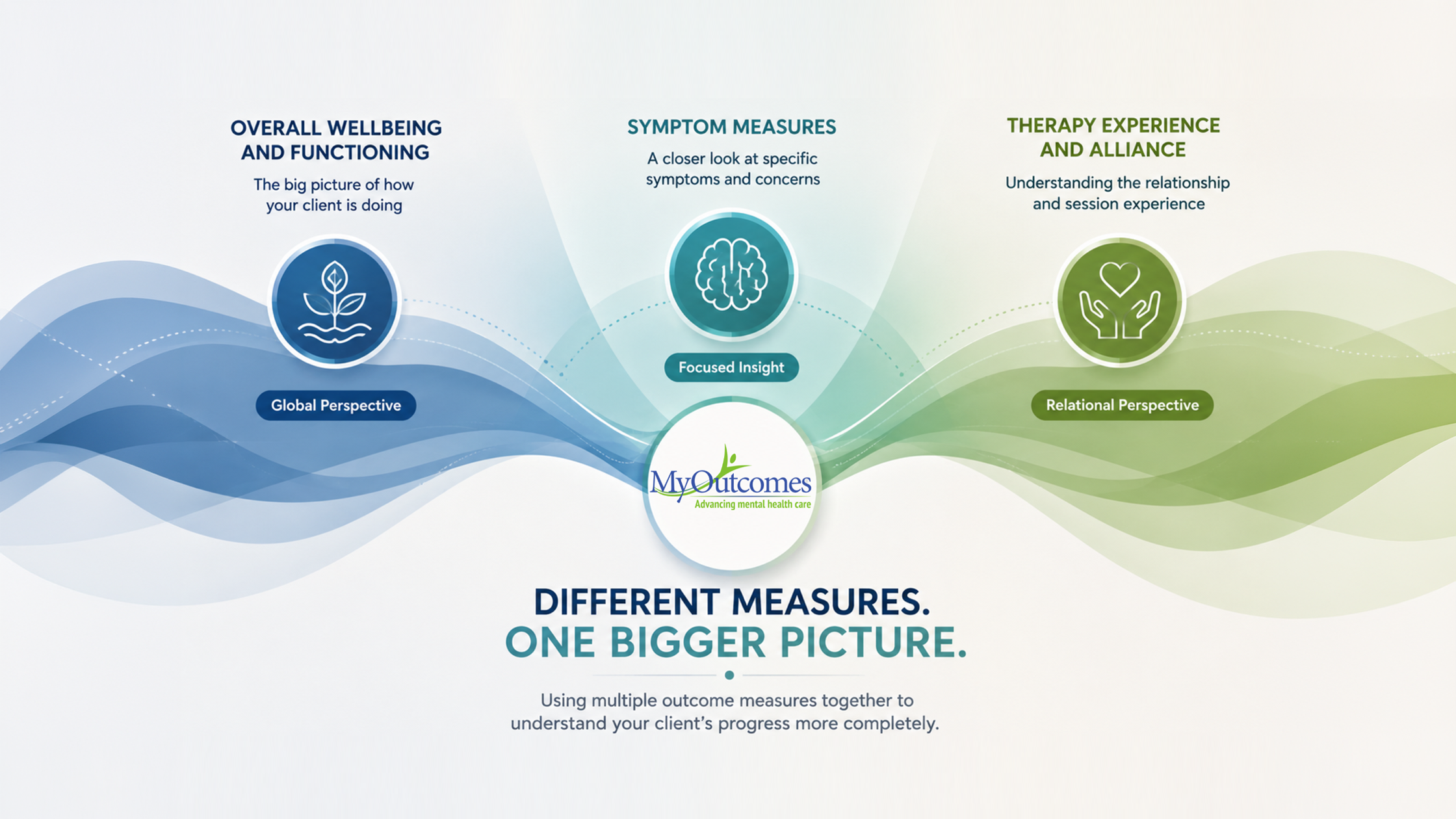
Therapists may use more than one type of outcome measure to understand how a client is progressing in therapy.
A global measure such as the Outcome Rating Scale (ORS) can provide a broad view of the client’s wellbeing and functioning. Symptom-specific measures such as the PHQ-9, GAD-7, or RCADS can provide more focused information about particular areas of concern.
Sometimes these measures move in the same direction.
Sometimes they do not.
A client’s ORS score may improve while their depression or anxiety symptoms remain elevated. A symptom measure may improve while the client’s overall wellbeing changes very little.
These differences do not necessarily mean that one measure is wrong.
They may be showing different parts of the client’s experience.
Understanding how to interpret different outcome measures can help therapists use therapy outcome data more thoughtfully and have more meaningful conversations with clients.
What Is the Difference Between the ORS and Symptom Measures?
One of the most important differences is what each type of measure is designed to capture.
The ORS provides a broad perspective on how a client is experiencing their overall wellbeing and functioning. It can help therapists and clients track changes in areas of life that matter to the client over the course of therapy.
Symptom-specific measures focus more narrowly on particular symptoms or areas of concern.
For example:
- PHQ-9 focuses on depressive symptoms.
- GAD-7 focuses on symptoms associated with generalized anxiety.
- RCADS assesses symptoms related to anxiety and depression in children and adolescents.
These measures can complement one another because they answer different questions.
A global outcome measure may help explore: “How is the client doing overall?”
A symptom measure may help explore: “What is happening with this particular area of concern?”
Neither perspective necessarily provides the complete picture on its own.
Why Can Therapy Outcome Measures Show Different Results?
It is possible for different measures to move in different directions during therapy.
For example, a client may report improved overall functioning while continuing to experience significant anxiety.
Another client may experience a reduction in depressive symptoms while still feeling that their relationships, work, or overall quality of life have not improved as much as they hoped.
There can be many reasons for these differences.
The measures are looking at different things
A broad measure and a symptom-specific measure may capture different aspects of the client’s experience.
Changes may happen at different rates
Symptoms may improve before those changes translate into broader improvements in functioning or wellbeing.
The client’s circumstances may have changed
External events, relationships, work, family circumstances, or other life factors can influence overall wellbeing even when specific symptoms are improving.
The client’s goals may extend beyond symptom reduction
A reduction in anxiety or depression may be important, but the client may also be working toward better relationships, functioning, confidence, or other personally meaningful goals.
This is why differences between measures can be useful information rather than something that needs to be immediately resolved.
What Does It Mean When ORS Improves but a Symptom Score Does Not?
Imagine a client whose ORS indicates that their overall wellbeing has improved, while their PHQ-9 or GAD-7 score remains relatively high.
This does not automatically mean that therapy is failing.
It may suggest that the client is experiencing improvement in areas captured by the ORS while still experiencing significant symptoms in a particular area.
That difference creates an opportunity for exploration.
A therapist might consider:
- What has improved for the client?
- Which areas of life feel different?
- What symptoms are still creating difficulties?
- Are the remaining symptoms affecting the client’s most important goals?
- Does the client feel that therapy is moving in the right direction?
The data can help identify where the conversation may need to go next.
What Does It Mean When Symptoms Improve but ORS Stays the Same?
The reverse situation can also occur.
A client may report fewer symptoms of depression or anxiety while their overall ORS score remains relatively stable.
Again, this does not necessarily indicate that the measures are conflicting in a problematic way.
It may mean that symptom improvement has not yet translated into broader changes in functioning or wellbeing.
For example, a client may experience less anxiety but continue to struggle with relationships, work, or other areas that are important to them.
This distinction can help therapists look beyond symptom reduction and consider the client’s broader goals and experience.
How to Interpret Conflicting Outcome Measure Results
When different therapy outcome measures tell different stories, it can be tempting to focus on which score is “right.”
A more useful approach is to treat the difference as an opportunity to learn more.
Look at the pattern over time
Avoid drawing conclusions from one isolated score.
Reviewing changes across multiple sessions can provide more context and help distinguish a temporary fluctuation from a more consistent pattern.
Consider what each measure is capturing
Ask whether the measures are addressing the same aspect of the client’s experience.
If they are measuring different things, differences between their results may be expected.
Bring the results into the conversation
The client can often provide context that the measures cannot.
For example: “I’m noticing that your overall wellbeing seems to be improving, while some of the anxiety symptoms are still quite persistent. How does that fit with your experience?”
The purpose is not to explain the score to the client.
It is to understand what the feedback means from their perspective.
Consider the client’s goals
Outcome data becomes more meaningful when connected to what the client wants to achieve through therapy.
A symptom may improve without the client feeling that they have made progress toward a personally important goal.
How to Use Multiple Outcome Measures in Therapy
Using multiple measures does not necessarily mean collecting as much information as possible.
The value comes from understanding what each measure contributes.
A therapist may consider:
ORS → broader wellbeing and functioning
SRS → the client’s experience of the session and therapeutic relationship
Symptom measures → specific areas of symptoms or concern
Together, these sources can provide different perspectives on the therapeutic process.
The important question is not: “How many measures are we using?”
It is: “What can we learn from the information we are collecting?”
This is an important principle in Measurement-Based Care: measurement should support clinical understanding and decision-making rather than become a collection exercise.
How Feedback-Informed Treatment Helps Make Sense of Different Scores
Feedback-Informed Treatment (FIT) provides a useful framework for bringing outcome information back into the therapeutic conversation.
When measures show different patterns, therapists can use the feedback to explore:
- what the client is experiencing;
- what appears to be improving;
- what remains difficult;
- whether therapy goals are still relevant;
- whether the current approach feels helpful;
- whether anything may need to change.
The purpose is not to make every measure tell the same story.
The purpose is to understand the different pieces of information and consider what they mean together.
This is where feedback becomes more than measurement.
Common Mistakes When Using Multiple Outcome Measures
Assuming one score must be more important than the others
Different measures may provide different types of information.
The most useful measure depends on the question being explored.
Overreacting to a single change
One unexpected result may not represent a meaningful trend.
Looking at patterns over time can provide better context.
Ignoring the client’s perspective
Outcome measures provide structured information, but clients can explain what is happening behind the numbers.
Using more measures without a clear purpose
Adding additional assessments does not automatically create better clinical insight.
Each measure should have a clear reason for being part of the therapeutic process.
Treating conflicting results as a problem
Differences between measures can reveal important information about the client’s experience.
Instead of asking which score is correct, therapists can ask what each result may be telling them.
Using Outcome Data to Support Better Clinical Conversations
The value of therapy outcome monitoring is not simply being able to see whether a score has changed.
The greater value comes from being able to notice something worth exploring.
For example: “Your anxiety score has improved over the last few sessions, but your overall wellbeing score has not changed as much. What are you noticing in your day-to-day life?”
A conversation like this can help connect structured measurement with the client’s lived experience.
The data provides a starting point.
The client provides the context.
Clinical judgement helps bring the information together.
Final Thoughts
ORS and symptom measures do not always tell the same story—and they do not necessarily need to.
A global outcome measure and a symptom-specific measure can highlight different aspects of a client’s experience.
When therapists look at these perspectives together, review patterns over time, and discuss differences with clients, outcome data can become a useful part of clinical decision-making.
Measurement-Based Care is not about choosing between numbers and clinical judgement.
It is about using meaningful information alongside professional expertise and the client’s own perspective to better understand therapy progress.
Looking for a better way to bring outcome data together?
MyOutcomes helps clinicians and organizations use structured feedback and outcome information to develop a more complete understanding of the client experience.
Request a quote to find the right solution for your team.