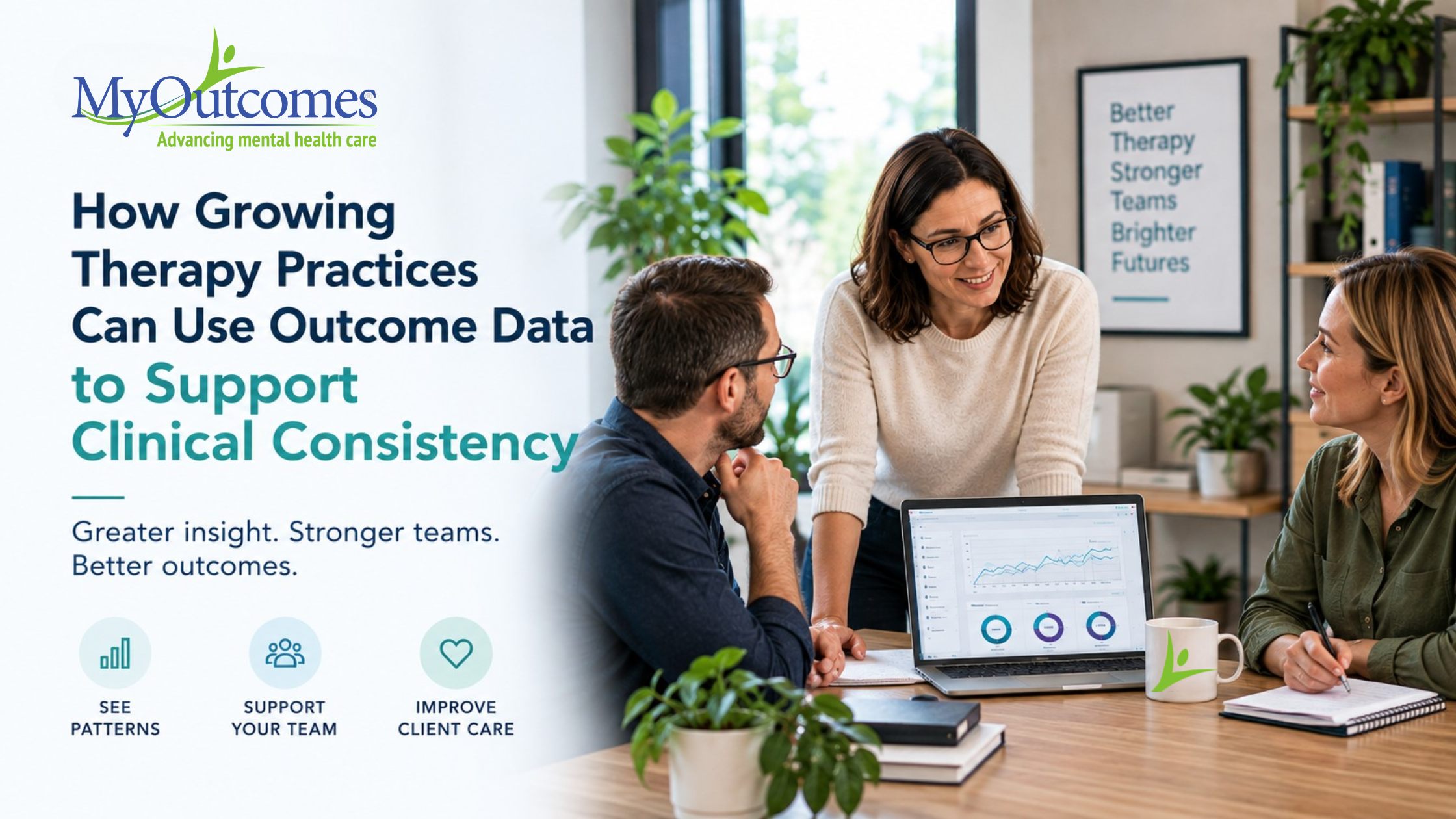
Growth can be a positive sign for a therapy practice.
More clinicians can mean more clients served, broader expertise, and greater capacity to meet the needs of a community.
But growth also changes how a practice sees its clinical work.
A solo therapist may have a direct view of every client and every session. As a practice expands to include multiple clinicians, teams, programs, or locations, it becomes harder to understand the broader picture through individual impressions alone.
This is where clinical outcome data can provide another layer of visibility.
Used thoughtfully, outcome data can help growing practices identify patterns, support professional learning, and understand how clients are experiencing care across the organization.
The goal is not to make every clinician practice in exactly the same way.
It is to create enough shared information to help a growing practice remain connected to the experience and progress of the people it serves.
Why Clinical Consistency Matters as a Practice Grows
Clinical consistency does not mean that every therapist should use the same therapeutic approach.
Different clinicians bring different training, experience, specialties, and therapeutic styles.
Instead, consistency can mean that a practice shares certain principles around how it understands and responds to client progress.
For example, a practice may want every clinician to have access to meaningful information about:
- how clients are progressing;
- how clients experience the therapeutic relationship;
- where progress may be changing;
- where additional clinical discussion may be useful.
As the number of clinicians increases, having a common source of outcome information can make these conversations easier.
This can be particularly useful for group practices, clinics, and behavioral health organizations where clinical work happens across multiple providers.
What Can Outcome Data Tell a Growing Practice?
Individual client data can help a therapist understand one person’s progress.
When information is viewed across appropriate groups or time periods, it can also help practice leaders see broader patterns.
For example, a practice may be able to explore questions such as:
- Are clients generally showing progress over time?
- Are there patterns in session feedback?
- Are some types of services showing different outcome patterns?
- Are there points in treatment where engagement changes?
- Where might additional clinical support or learning be useful?
These questions are not about producing a single number that defines the quality of a practice.
They are about creating better visibility into clinical work.
Outcome data can provide another perspective alongside clinical judgment, professional experience, client conversations, and other sources of information.
What Clinical Consistency Does—and Does Not—Mean
A growing practice may understandably want consistency.
But consistency should not become standardization for its own sake.
Outcome data should not be used to suggest that every client should follow the same path or that every clinician should produce identical results.
Therapy is influenced by many factors, including:
- client needs;
- presenting concerns;
- treatment goals;
- therapeutic approach;
- setting;
- length of treatment;
- client circumstances.
The value of outcome data is therefore not in making every case look the same.
It is in helping a practice notice patterns without losing sight of individual clients.
Using Practice-Level Outcome Data Without Ranking Clinicians
One of the most important considerations when using outcome data across a growing practice is how the information is interpreted.
Practice-level data should support learning and improvement—not reduce clinical work to a leaderboard.
For example, if one clinician’s outcomes look different from another’s, there may be many possible explanations.
The appropriate response is not necessarily: “Who is performing better?”
A more useful question may be: “What can we learn from this pattern?”
Differences can prompt thoughtful exploration around caseloads, client populations, treatment settings, referral patterns, clinical approaches, or other contextual factors.
This approach keeps the focus on understanding rather than simplistic comparison.
Use Outcome Data to Identify Questions, Not Just Answers
One of the most useful ways a practice can work with outcome data is to treat it as a starting point for better questions.
For example: A practice notices that some clients show limited progress after several sessions.
- Are treatment goals being reviewed regularly?
- Are there particular client groups represented in this pattern?
- Would additional supervision or consultation be useful?
- Are clinicians encountering a common clinical challenge?
- Is there something about the practice workflow worth examining?
The data does not automatically answer these questions.
It helps make them visible.
This is one reason Measurement-Based Care can be useful at both the individual and organizational level: information can support clinical decisions while also helping practices reflect on how care is being delivered.
Balancing Practice-Wide Visibility With Clinical Autonomy
A growing practice needs enough structure to function effectively without removing professional autonomy.
Outcome data can contribute to that balance.
A practice can establish a shared framework for collecting and reviewing information while allowing clinicians to determine how they apply that information within their professional judgment.
For example:
Shared: Client feedback is collected and outcome information is available.
Individual: The clinician considers the information alongside the client’s goals, presentation, clinical context, and professional judgment.
This distinction is important.
The purpose of outcome measurement is not to replace the therapist’s expertise.
It is to provide another source of information that can make the client’s experience and progress more visible.
How Outcome Data Can Support Professional Learning
As a practice grows, clinicians can learn not only from their own cases but also from patterns across the wider organization.
For example, a practice may discover that a particular clinical challenge appears repeatedly across different caseloads.
That observation could lead to:
- peer discussion;
- targeted training;
- consultation;
- supervision topics;
- deliberate practice;
- closer examination of client feedback.
This creates an opportunity to move from:
“We have data.” to: “What can our practice learn from it?”
The broader goal is continuous professional development, supported by information from real clinical work.
When Practice-Level Patterns Raise Useful Questions
For example, a practice might notice:
- a change in progress patterns over time;
- differences between programs or services;
- recurring alliance concerns;
- changes in client engagement;
- areas where clinicians would benefit from additional support.
How This Can Support a Growing Practice
As a practice expands, leaders need ways to understand what is happening across the organization without becoming involved in every individual clinical decision.
Outcome data can provide a useful layer of visibility.
It can help leaders ask:
Where are clients making progress?
Where might additional support be useful?
What patterns are emerging?
What should we explore more closely?
How can we support our clinicians?
This is different from using data simply for reporting.
It is using information to support thoughtful practice development.
Outcome Data Should Support Better Conversations
The most useful outcome data does not end with a report.
It creates an opportunity for conversation.
A clinician might discuss a client’s progress with a supervisor.
A supervisor might identify a useful learning opportunity.
A practice leader might notice a broader pattern.
A team might explore whether additional training would be helpful.
And a client can remain at the centre of the process by having their experience represented in the information being reviewed.
This is where outcome measurement can become more than tracking.
It can become part of how a practice learns.
Final Thoughts
As a therapy practice grows, maintaining visibility into clinical work becomes more challenging.
Outcome data can help provide that visibility without requiring every clinician to work in exactly the same way.
Used thoughtfully, it can help practices recognize patterns, support professional learning, strengthen clinical conversations, and identify areas worth exploring.
The goal is not to turn therapy into a numbers exercise.
It is to give clinicians and practice leaders another source of information that can complement clinical expertise and client experience.
For a growing practice, that can create a stronger foundation for learning while preserving what matters most:
individualized care, professional judgment, and the client’s voice.
Growing your practice and looking for better clinical visibility?
MyOutcomes helps growing therapy practices, clinics, and organizations use outcome data to support learning, reporting, and client-centred care.
Request a quote to explore the right solution for your organization.